The Nigerian Government has launched critical emergency medical assets and health infrastructure projects nationwide as part of efforts to strengthen healthcare delivery under the Renewed Hope Agenda of President Bola Ahmed Tinubu.
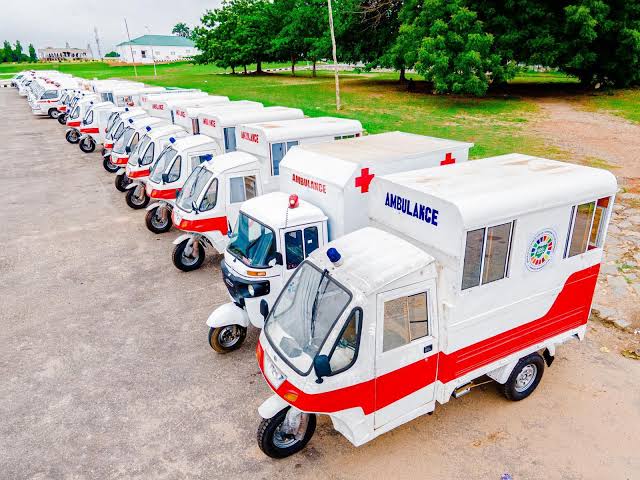
Speaking during the virtual presidential launch on Friday, the Minister of State for Health and Social Welfare, Dr Iziaq Adekunle Salako, said the initiative featured the deployment of 145 tricycle ambulances and six boat ambulances, as well as emergency communication and dispatch equipment under the National Emergency Medical Service and Ambulance System (NEMSAS).

“The investments reflect a bold national vision where no Nigerian should lose their life because structured medical help could not reach them in time,” Salako said.
The minister also disclosed that several health infrastructure projects were commissioned across the country, including Emergency Operations Centres in Kano, Sokoto and Katsina states; the Lagos Vaccine Hub; and specialised facilities in federal teaching hospitals and medical centres.
According to him, the projects are designed to improve trauma care, mental health services, maternal healthcare, diagnostics and disease outbreak preparedness.
Highlighting achievements recorded in the health sector over the last three years, Salako said the Federal Government had expanded health insurance coverage by more than 33 per cent, revitalised over 4,000 primary healthcare centres, and established 15 new federal tertiary health institutions nationwide.
He thanked President Tinubu for his “visionary leadership and steadfast support to the health sector”, adding that the administration remained committed to building “a resilient, people-centred health system that delivers hope, dignity, and quality healthcare for all Nigerians.”
Representing President Bola Ahmed Tinubu at the commissioning ceremony, the Permanent Secretary of the Federal Ministry of Health and Social Welfare, Daju Kachollom, mni, described the deployment of the ambulances as a major milestone for the nation’s health sector and underserved communities.
Kachollom said the ambulances would be stationed at primary healthcare centres across the country to support maternal and child healthcare services, particularly in rural communities where access to emergency medical care remains a challenge.
“This is a milestone for the Ministry of Health, for the rural and urban communities,” she said, noting that the initiative had taken five years to actualise.
She commended the World Bank and development partners for supporting the project and expressed optimism that the intervention would significantly improve Nigeria’s health outcomes and statistics.
According to her, trained drivers and nurses would accompany the ambulances, while emergency call numbers would also be made available at the primary healthcare centres to ensure a swift response during emergencies.
The Permanent Secretary further disclosed that six boat ambulances had already been deployed to riverine communities to strengthen healthcare delivery in hard-to-reach areas.
“These ambulances are going down to the rural areas and they will be stationed at the primary health care centres,” she stated.
Kachollom added that the health sector had recorded remarkable progress under the Renewed Hope Agenda of President Tinubu over the last three years, expressing confidence that Nigerians would witness better health outcomes before the end of 2027.
She assured the President of the ministry’s continued commitment to delivering quality healthcare services across the country.