The Minister of Women Affairs and Social Development, Imaan Sulaiman-Ibrahim, says Nigeria is repositioning its social protection strategy from repeated emergency assistance and fragmented palliatives to sustainable productivity, family resilience and shared prosperity.
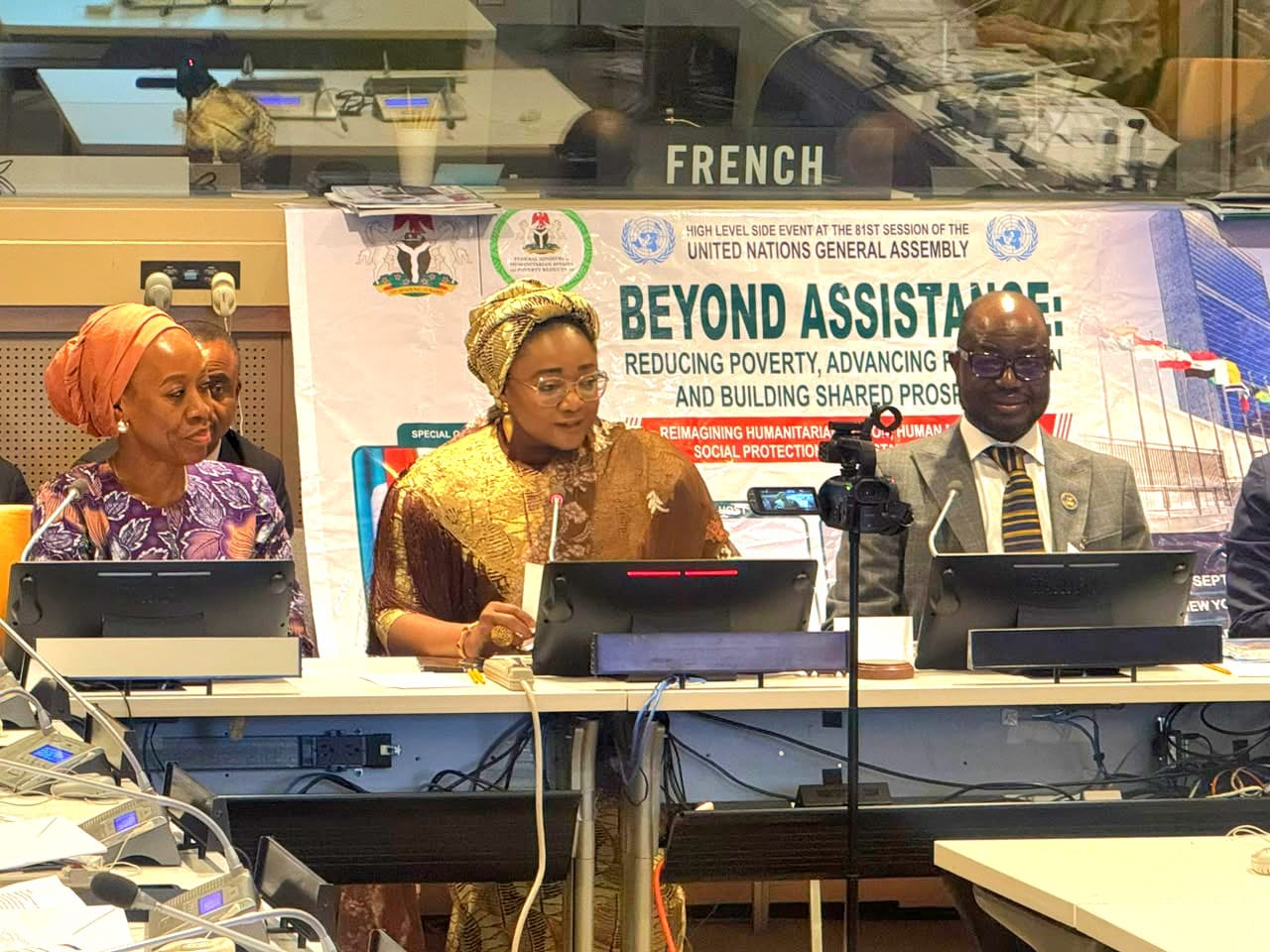
Sulaiman-Ibrahim stated this at a high-level side event of the 81st Session of the United Nations General Assembly, UNGA 81, convened by the Federal Ministry of Humanitarian Affairs and Poverty Reduction themed “Beyond Assistance: Reducing Poverty, Advancing Protection and Building Shared Prosperity Reimagining Humanitarian Action, Human Mobility and Social Protection for Sustainable Futures”.
While commending the Minister of Humanitarian Affairs and Poverty Reduction, Dr Bernard Doro, and the organisers for advancing a more integrated approach to humanitarian action, she said:
“By championing a decisive paradigm shift from repeated, fragmented palliatives toward sustainable productivity and shared prosperity, the Ministry of Humanitarian Affairs and Poverty Alleviation is demonstrating precisely the integrated, forward-looking governance that Nigeria and the wider global South require today.”
The minister said the Federal Ministry of Women Affairs and Social Development was focused on moving citizens from vulnerability and fragility through resilience to sustainable prosperity.
“At the Ministry of Women Affairs and Social Development encompasses social development in its absolute entirety, guiding citizens across the full spectrum from fragility, through resilience, to ultimate prosperity.”
She said Nigeria was increasingly prioritising human capital, community infrastructure and economic self reliance, with the Renewed Hope Social Impact Interventions, RH-SII, serving as the ministry’s core delivery mechanism for social development.
“Through the RH-SII framework, we ensure that true, long-term social development is anchored where life actually happens in the home and within the family unit.”
Sulaiman-Ibrahim said President Bola Ahmed Tinubu had designated 2026 as the Year of Family and Social Development, with the initiative transitioning into the Decade of Families, 2026 to 2035.
She identified women’s economic empowerment, family strengthening, child protection and support for vulnerable persons as key priorities, stressing the need to integrate displaced women into host community development frameworks.
“Prioritising the economic empowerment of women, the strengthening of families, the safeguarding of children, and the protection of vulnerable persons, our interventions must reach everyone in need, from the women in urban locations to the displaced women in camps, integrating them directly into host community development frameworks while breaking the intergenerational cycle of poverty.”
The Minister said sustainable protection required coordinated action across government, UN agencies, international financial institutions, development partners and private investors.
“The journey toward sustainable protection requires us to treat human dignity, family cohesion, and economic self-reliance not as separate mandates, but as one unified national commitment.”
She reaffirmed the ministry’s commitment to building nationally owned systems that transform emergency response into long-term investments for Nigerian women, children and families.
The event, supported by the International Organisation for Migration, European Union and other partners brought together governments, UN entities, development partners, private sector, civil society and communities to chart a course to move from assistance to sustainable prosperity.