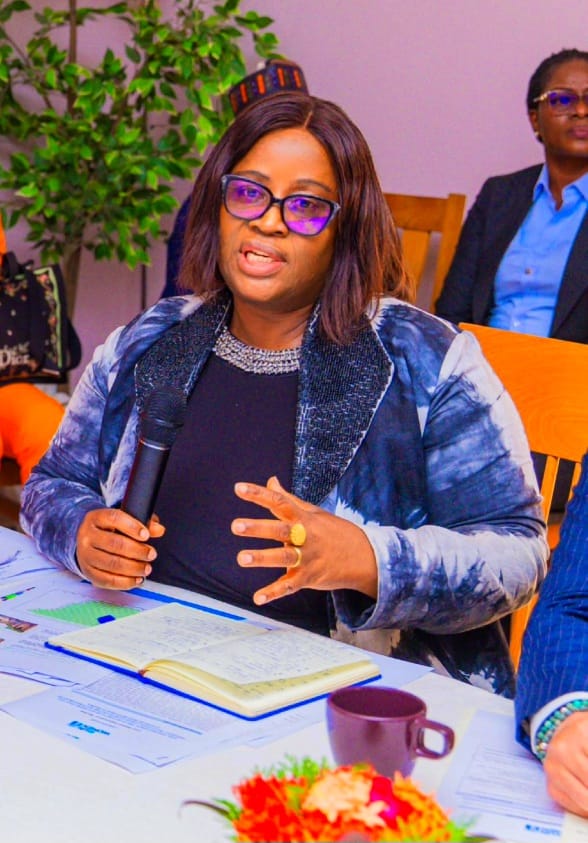
The United Nations Women Representative to Nigeria and ECOWAS, Beatrice Eyong, says Nigeria has recorded significant progress in the implementation of the Women, Peace and Security (WPS) Agenda through strengthened institutions, expanded participation of women in peacebuilding processes, enhanced security sector reforms and increased localisation of the National Action Plan (NAP) on United Nations Security Council Resolution (UNSCR) 1325.
Eyong stated this while delivering a presentation on the “25th Anniversary of UNSCR 1325: Nigeria’s Progress, Challenges, Lessons Learnt and the Way Forward” at the Meeting of Like-Minded Ambassadors for Gender Equality and Women Empowerment in Abuja.
She noted that the Women, Peace and Security Agenda has evolved into a comprehensive global framework for promoting women’s participation and protection in peace and security processes.
“Today we have all together 10 resolutions on women, peace and security adopted. This is what created the policy framework referred to as the women, peace and security agenda,” she said.
According to the representative, “The WPS agenda follows three tracks and has four pillars”, including participation, protection and “the integration of a gender perspective in all international peace and security missions and operations.”
Eyong stressed that women and girls remain among the most affected by insecurity.
“Women and girls have been disproportionately affected by the conflicts, experiencing sexual violence, forced marriages, and recruitment as combatants, informants, or suicide bombers,” she said.
Highlighting achievements under Nigeria’s implementation of the WPS Agenda, Eyong disclosed that State Action Plans and Local Action Plans had been adopted in 17 states and 21 local government areas, respectively, with implementation and monitoring structures already operational.
She said women led peacebuilding mechanisms were yielding measurable results across several states.
“851 Women Mediators with over 5000 Network members across 8 states are actively engaged in Peacebuilding processes in 8 states,” she stated.
According to her, more than 800 women have also been integrated into traditional councils as members and advisers participating in decision-making and peacebuilding processes.
On security sector reforms, Eyong said gender policies had been adopted by major security institutions, including the Armed Forces of Nigeria, Nigeria Police Force, Nigeria Security and Civil Defence Corps and the Department of State Services.
She noted that “Nigeria’s Armed Forces achieved 27.9% female participation in peacekeeping operations in 2023, surpassing the UN-recommended benchmark of 17%.”
Despite the gains, Eyong identified weak political will, inadequate budgetary allocations, limited representation of women in peace and security structures, weak coordination mechanisms, capacity gaps and low awareness levels as key challenges affecting implementation of the first and second National Action Plans.
“Nigeria has grappled with persistent conflicts, insecurity, and natural disasters, resulting in widespread population displacements across the country,” Eyong stated.
She added that climate-related pressures have compounded existing vulnerabilities.
“Climate change has further exacerbated these issues with environmental stressors like floods, droughts and resource scarcity, worsening social cohesion and increasing competition for resources, fuelling conflict, poverty and displacement.”
Eyong stated that lessons from previous implementation cycles informed the development of the Third National Action Plan through a broad-based consultative process coordinated by the Federal Ministry of Women Affairs with support from UN Women and Norway.
“The 3rd NAP was officially launched on 15th December 2025 at the State House, Abuja. There is strong commitment for the 3rd NAP by Government for implementation, localisation, coordination.”
She said the plan prioritises addressing protracted insecurity, climate-related challenges, sexual and gender-based violence, technology-facilitated insecurity, women’s participation in peace and security institutions, and stronger coordination and compliance mechanisms.
“The 3rd NAP provides a comprehensive framework for the implementation of UNSCR 1325,” Eyong stated.
She further affirmed that “UN Women is providing technical support to the Government, including leveraging its comparative advantage and the various established WPS structures and partners at national, state and grassroots levels.”
Calling for greater support from development partners, she said, “There is need for the Like-Minded Ambassadors to support the Government of Nigeria to fully operationalise the NAP, including localisation across the 36 states of the federation and FCT.”
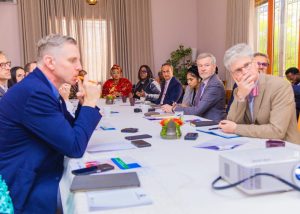
The GEWE Like-Minded Ambassadors meeting, themed “Resolution 1325: Progress, Challenges, Lessons Learnt and the Way Forward after 25 years of implementation in Nigeria”, co-chaired by Gautier Mignot and Svein Bæra, ambassadors of the EU and Norway to Nigeria, provided a platform to review progress, challenges and lessons learnt since the adoption and domestication of UNSCR 1325 in Nigeria.