The Nigerian Government has commenced nationwide consultations on the proposed National Policing Bill.
As part of efforts to establish a comprehensive legal and operational framework for state policing across the country, the government is inviting Nigerians at home and abroad to submit memoranda and policy proposals
As part of the reform process, the Working Group has also begun a comprehensive review of the Police Act 2020, the Police Service Commission framework, police regulations and other relevant laws to develop a modern policing system anchored on national minimum standards, state readiness and certification, federal-state cooperation, clear jurisdictional responsibilities, independent oversight, human rights safeguards, interoperable data systems, sustainable funding arrangements and an orderly transition to a dual-policing architecture.
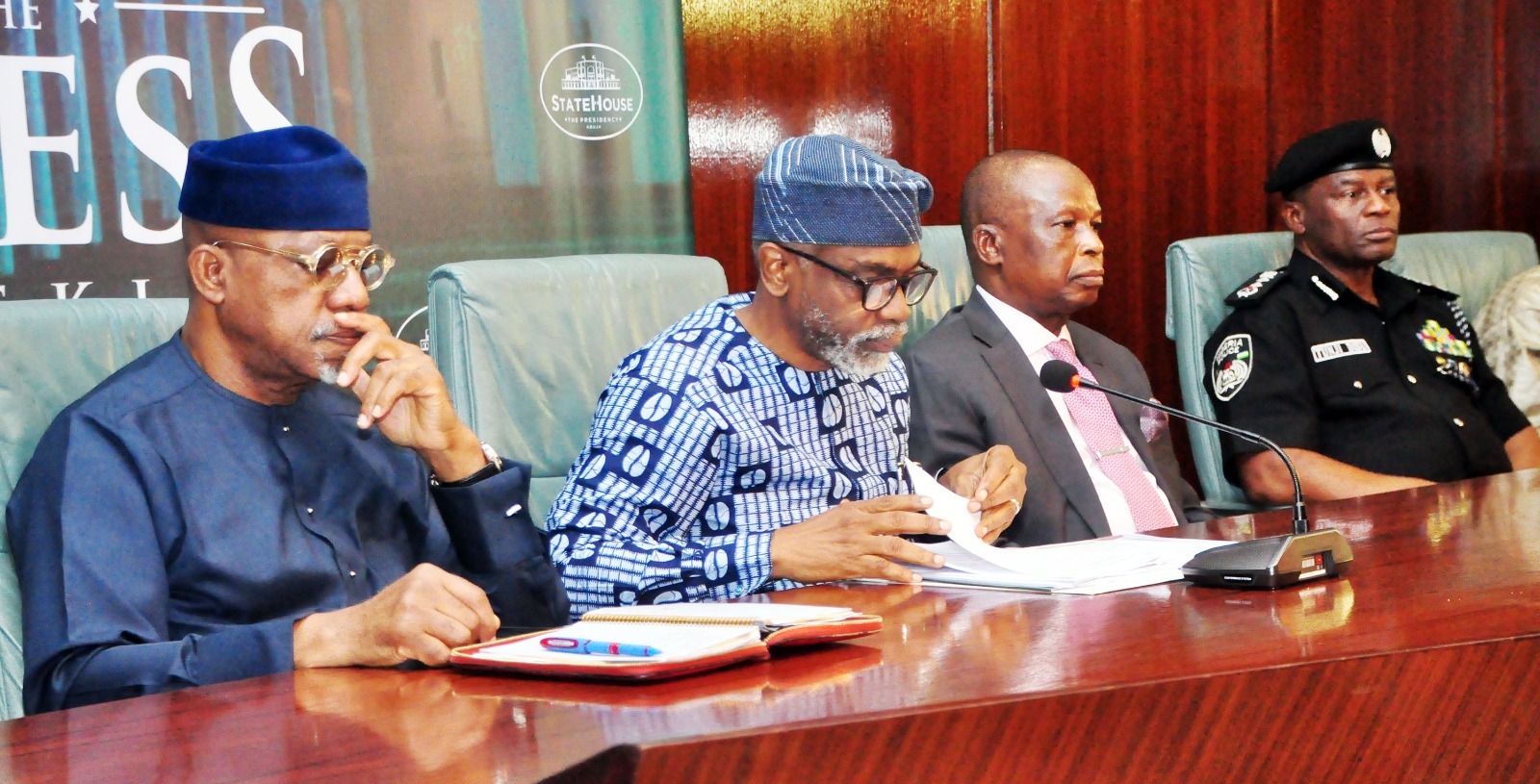
The Chief of Staff to the President and Chairman of the Presidential Working Group on the National Policing Bill, Rt. Hon. Femi Gbajabiamila, announced on Monday while briefing State House Correspondents after the Working Group’s meeting at the State House, Abuja.
Gbajabiamila said the open call for memoranda would run for two weeks, allowing citizens, professional bodies, civil society organisations, security institutions, state and local governments, market associations, academics and other stakeholders to make meaningful contributions to the proposed legislation.
He said all submissions would be collated, categorised by theme and reflected in the legislative process, assuring that when the draft bill is completed, Nigerians would have another opportunity during a national consultation to examine its provisions, including safeguards, funding mechanisms and transition arrangements.
“The timetable is demanding, but it is not a shortcut. Legal drafting, policy research, data analysis and implementation modelling will proceed in parallel with fixed review gates.”
Gbajabiamila disclosed that the Working Group had adopted a seven-week, milestone-driven work programme running from July 27 to September 14, 2026, with administrative and technical preparations already underway to drive the reform process.
He said the Executive Bill package is scheduled for presentation to President Bola Ahmed Tinubu on September 3, 2026, emphasising that the drafting process would not be rushed despite the timeline.
“Administrative and technical preparations have been underway, and today’s meeting formally mobilises the next stage. The resulting Executive Bill package is scheduled for presentation to the President on the 3rd of September.
“The national consultation will come before the President’s final approval, after which the text and supporting materials will be revised and prepared for formal transmission to the National Assembly. The timetable is demanding, but it is not a shortcut. Legal drafting, policy research, data analysis and implementation modelling will proceed in parallel with fixed review gates.
Gbajabiamila said the Working Group’s final submission would extend beyond the proposed National Policing Bill, incorporating a comprehensive legislative and implementation framework to facilitate a smooth transition to a dual-policing system.
He explained that the package would include schedules to the bill, an explanatory memorandum, a legal audit, a consequential amendments matrix, a clause-by-clause analysis, a State readiness framework, a fiscal and implementation note, an implementation work plan, a validation report, a risk register and a controlled digital archive.
The Chairman noted that the proposed legislation is designed to establish a clear legal and operational framework for federal and state policing, with implementation anchored on national standards, institutional accountability and operational readiness.
According to him, “the framework provides for national minimum policing standards, objective assessment and certification of state readiness, federal-state and interstate cooperation, clearly defined jurisdictional responsibilities, independent personnel and complaints institutions, human rights and use-of-force safeguards, as well as harmonised provisions on rank equivalence, transfer, secondment and pension portability.
He added that the proposed reforms also address criminal information management, forensic and interoperable data systems, firearms regulation, funding arrangements and grant conditions, federal intervention mechanisms, and the orderly transition of existing security outfits, assets, liabilities, records and pending cases.
He explained that “A proposed State Police Service must demonstrate that it has credible arrangements for recruitment, vetting, training, pay, pensions, equipment, custody, complaints, discipline, data, firearms control, independent oversight and financial sustainability before it begins policing.”
“Operational commencement must also be based on readiness, not announcement.
The Chief of Staff further assured that the proposed framework would guarantee uniform minimum standards of policing nationwide while allowing states to improve on provided standards where necessary.
“National standards will be the baseline. States may establish higher standards. However, no Nigerian should receive a lower standard of protection because of where they reside,” he said.
He also underscored the safeguards built into the proposed legislation to prevent abuse of the state policing system, insisting that policing must remain subject to constitutional and legal oversight rather than political control.
“Gbajabiamila said the proposed framework is anchored on the principle that local policing must operate within strong national safeguards, stressing that “State Police cannot mean 36 state militias.”
He added that law enforcement officers must remain accountable to the Constitution and the rule of law, insisting that “Officers must answer to the Constitution and the law, not to personal or partisan instruction.”
Present at the briefing were the Inspector General of Police, Tunji Disu; Representative of the Nigerian Governors’ Forum and Governor of Ogun State, Dapo Abiodun; President of the Nigerian Bar Association, Afam Osigwe; Chairman, Policy Advisory Committee, Justice Abdullahi Liman; and Special Adviser to the President on Planning and Research, Nnadubem Moghalu.