Nigeria’s Vice President, Kashim Shettima, has endorsed healthy competition among the 36 states of the federation, describing it as essential to achieving the nation’s aspirations for prosperity, economic growth, human dignity and job creation.
This, he said, is evident in the quality and ambition of the investment summits organised by the states across the country.
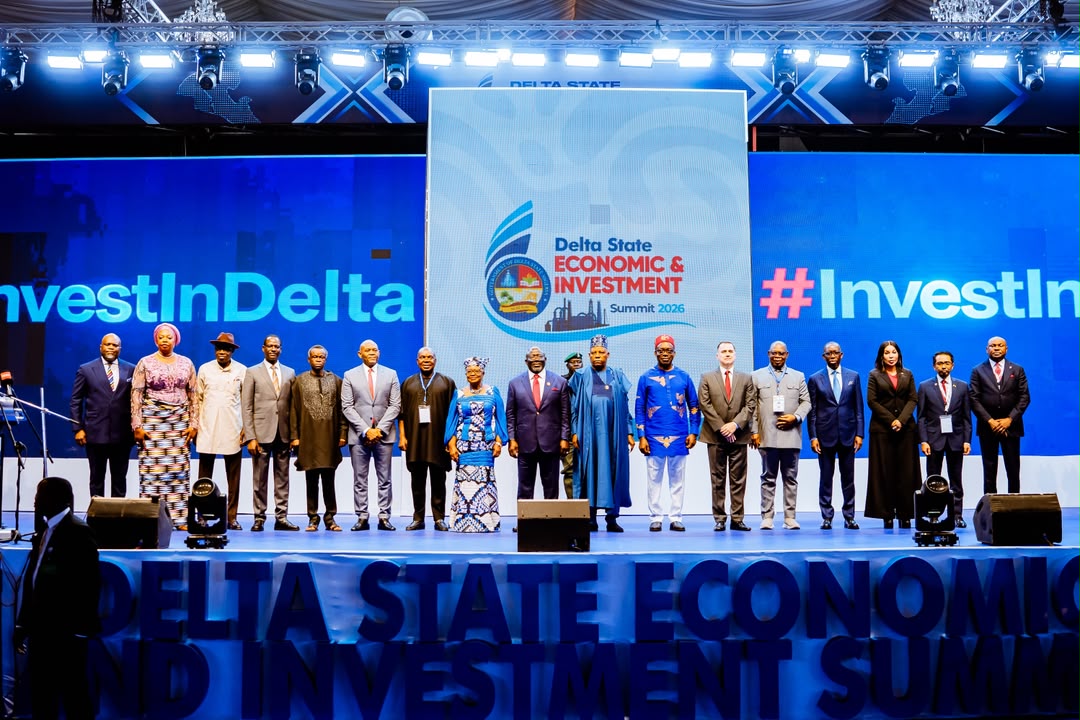
The Vice President stated this on Monday in Asaba, the Delta State capital, during the state’s Economic and Investment Summit 2026.
He emphasised that the nation’s strength lies in the proactive economic awakening of its sub-national governments rather than just the government at the centre.
“The cycle of competition among our states is now evident in the quality and ambition of the investment summits convened across the federation. Every state possesses immense promise, but each must define a trajectory unique to its history, geography, people and comparative advantage.
“This is the race we must welcome: a race that proclaims growth rather than conflict, a race in which the prize is employment, prosperity and human dignity, a race for the future,” the VP said.
VP Shettima stated that the attendant economic and investment summits stem from the strong economic foundation laid by President Bola Tinubu, which has increased federal allocations for local development.
He said, “This season of summits owes itself to two developments. The first is the stronger foundation laid by the economic reset of President Bola Ahmed Tinubu, which has placed far larger allocations in the hands of state governments to pursue their internal development agendas.
“The second is that no state wishes to be trapped in the dilemma of having money but not knowing how to spend it. For rescuing us from that dilemma, I believe Mr President deserves a round of applause.”
VP Shettima recalled the promise made by the Tinubu administration to place the nation on the path of growth, noting that it is the reason each meeting had become “another platform for turning that promise into enterprise.”
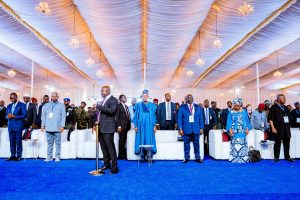
While noting that every host state contributes to the nation’s commercial ambition, he said, “One highlights agriculture, another minerals, technology, ports, energy or tourism. In that healthy rivalry, Nigeria discovers the full measure of her wealth.”
Right Path
The Vice President acknowledged that Nigeria is currently on the right path in its growth and development trajectory, citing the reports of international ratings agencies like Fitch, S&P and Moody’s as confirmation of what he described as the nation’s “direction of travel.”
He commended Delta State Governor Sheriff Oborevwori for what he described as the governor’s bold steps towards building a greater Delta, saying he had created a platform that aligns with the aspirations of the people.
He said that the state’s greatest advantage extends beyond its oil wealth.
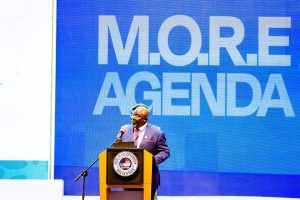
The state’s advantage, the VP noted, lies in its conviction behind the economic and investment summit that the future of a people cannot be deposited in a single commodity.
“Diversification is an instinct of economic self-preservation and a measure of the quality of leadership. A government that prepares for life beyond oil understands that resources may finance progress, but only ideas, institutions and enterprise can sustain it,” he added, expressing confidence in Governor Oborevwori’s ability to lead “Delta into a new era of productive expansion.”
Assurance
VP Shettima assured investors, entrepreneurs, financiers, captains of industry, innovators and development partners at the summit that the federal government “stands ready to support credible investments, strengthen enabling institutions and work with the state to remove obstacles to enterprise.”
In his address of welcome, Governor Oborevwori said the summit is the result of the bold step he took last year when he led his cabinet members to China and Brazil to harness investment opportunities for Delta State.
He noted that the summit is designed to connect ideas with capital and maximise the comparative advantages inherent in the state’s socio-economic potential.
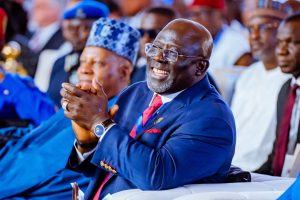
The Governor thanked the Vice President for the honour of gracing the summit, lauding his exemplary leadership and the vital role he is playing in advancing the nation’s collective good.
Also speaking, the Governor of Anambra State, Prof. Charles Soludo, expressed solidarity with his Delta State counterpart, agreeing that from a macroeconomic standpoint, Nigeria has stabilised and is now on the rise.
He, however, maintained that Nigeria will require foreign capital to thrive, even as he called for networking among stakeholders, adding that “deals are the real thing” at any economic summit.
Director-General of the World Trade Organisation, Dr Ngozi Okonjo-Iweala, congratulated the state governor on the developmental strides his administration is making, observing that despite the current global disruptions, there are significant opportunities for Delta State, Nigeria, and the entire African continent to maximise.
The former Finance Minister called for fiscal prudence, lower trade costs, improved execution, and a stronger maintenance culture in the state and Nigeria at large.
Minister of Finance, Taiwo Oyedele, said states and local governments are now receiving unprecedented revenues due to President Tinubu’s Renewed Hope Agenda, which has helped to establish macroeconomic stability.
He called on states and entrepreneurs to play their respective roles in driving the nation’s shared prosperity.
Founder and Chairman of Heirs Holdings, Chief Tony Elumelu, congratulated the Governor on his efforts to develop the state, saying Delta State is now safe and hospitable for investment.
He promised to partner with the state government to make electricity distribution more accessible and affordable for the people.
Guest Speaker at the event, Prof. Patrick Lumumba, urged stakeholders to recognise that oil and all of Africa’s assets must be fully utilised.
He called on Africa to move towards a “symbiotic relationship” with foreign jurisdictions rather than “parasitic relationships,” stressing that Africans should be seen as investors, while Brazil, China, Europe, and the United States should be regarded as partners of goodwill.