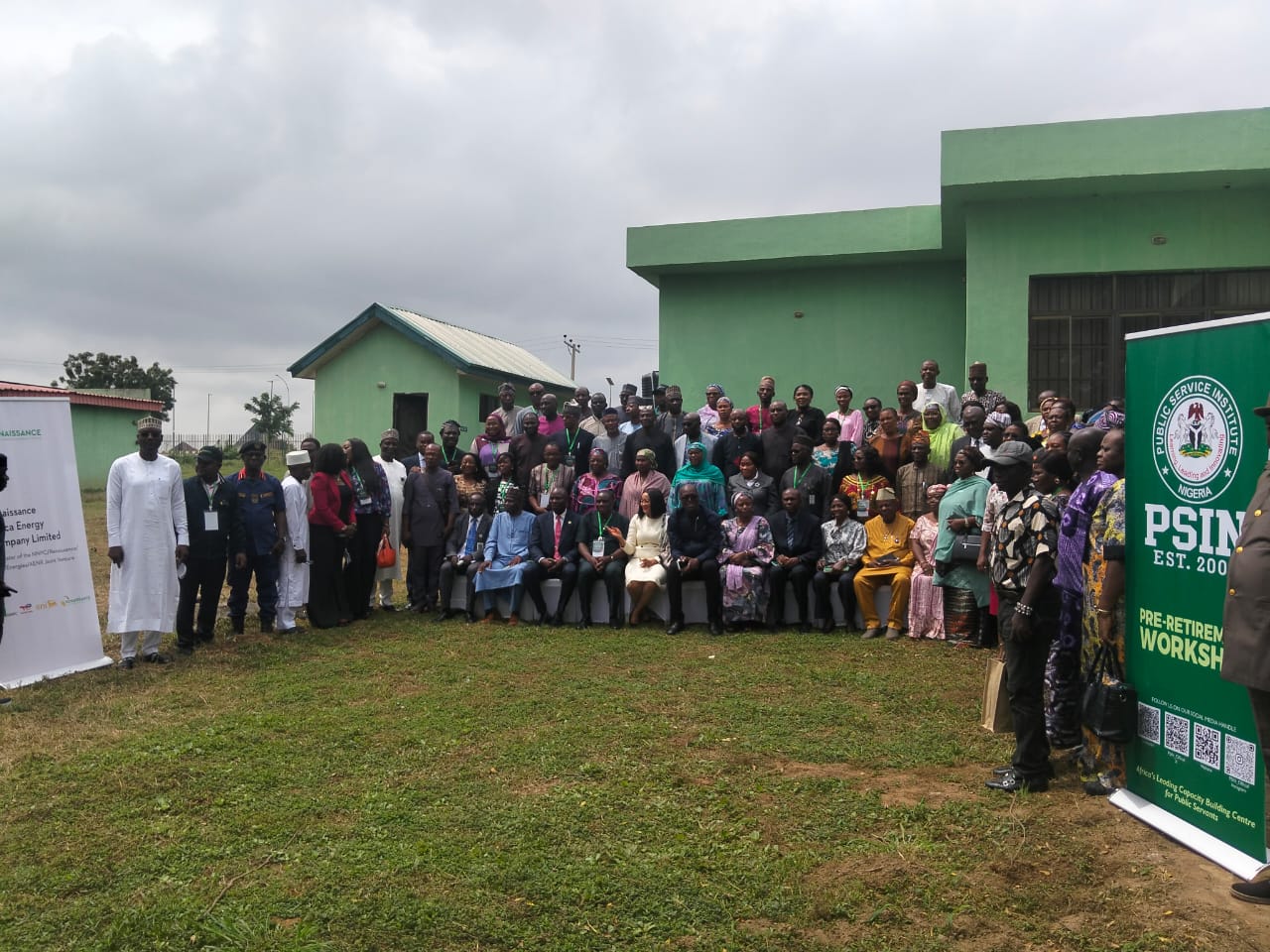
The Public Service Institute of Nigeria (PSIN), in partnership with Renaissance Africa Energy Company Limited has urged civil servants approaching retirement to begin preparing early for life after public service.
The call was made during a pre-retirement sensitisation and capacity-building workshop organised by PSIN in partnership with Renaissance Africa Energy to equip public servants with the knowledge and skills required to make a successful transition from active service to retirement.
Speaking at the event, the Chief Executive Officer of PSIN, Ime Okon, said the initiative was designed to appreciate civil servants who had devoted decades of their lives to serving the country while helping them prepare for a productive and fulfilling post-service life.
Okon said “for over 35 years, some of them 30, 32, 35 years, they’ve given all their best to Nigeria. And so this time that they are leaving, we want everybody to feel very confident in the fact that they’ve done their best. And now they have to face their own future”.
Framework for Retirement
She explained that the workshop was part of efforts to establish an early preparation framework for retirement, rather than waiting until an officer was about to leave service.
READ ALSO: Nassarawa State Government Holds Pre-retirement Skills Training For Civil Servant
According to her, civil servants should begin planning for their post-service lives four or five years before retirement.
“We don’t want anybody to leave suddenly. We don’t want anyone to leave unprepared. We want them to feel confident that life after civil service can also be very productive,” Okon said.
The PSIN Boss said that the programme would focus on key areas including psychological transition and legacy, financial management and wealth preservation, entrepreneurship, pensions, entitlements and wellbeing.
Okon said the institute would also help participants identify their interests and professional expertise and explore ways of transforming them into sustainable businesses, consultancy opportunities, mentorship and other productive engagements after retirement.
Retirement with Confidence
Vice President, Relations and Sustainable Development, Renaissance Africa Energy Company Limited, Igo Weli, said the partnership with PSIN was aimed not only at giving back to public servants but also at helping them approach retirement with confidence and a clear sense of purpose.
Weli acknowledged the role of government ministries, departments and agencies in supporting the company’s operations, saying the programme was also an opportunity to appreciate public servants for their contributions.
Beginning of a new Chapter
He said retirement should not be viewed as the end of a person’s productive life but as the beginning of a new chapter.
“Some people go into retirement with fear, when they should go in with excitement and with a clear plan of what to do,” Weli said.
He noted that many people had experienced significant improvements in their material circumstances, health and work-life balance after retirement.
Weli pledged that the initiative would be sustained beyond a single workshop, describing PSIN as an important partner in efforts to prepare public servants for the next phase of their lives.
General Manager, Business Relations, Renaissance Africa Energy Company Limited, Enobonge Ekanem, said those who had devoted their working lives to Nigeria deserved to benefit from the opportunities available in the country.
“We believe that those who suffer, those who strive, those who work hard for Nigeria also deserve to enjoy Nigeria,” Ekanem said.
He said the programme was intended to provide retiring workers with a framework for managing their resources, planning for the future and transferring knowledge to younger generations.
Ekanem also linked the initiative to the broader development aspirations of Renaissance Africa Energy, saying collaboration between the private sector and government institutions was important to achieving sustainable economic growth.
He said the company currently produces about 140,000 barrels of oil and is targeting production of 300,000 barrels by the end of the year and 500,000 barrels by 2030.
According to him, achieving such targets would require continued cooperation with government ministries, departments and agencies.
He said increased economic activity and production would contribute to greater opportunities for Nigerians, including younger people entering the labour market.