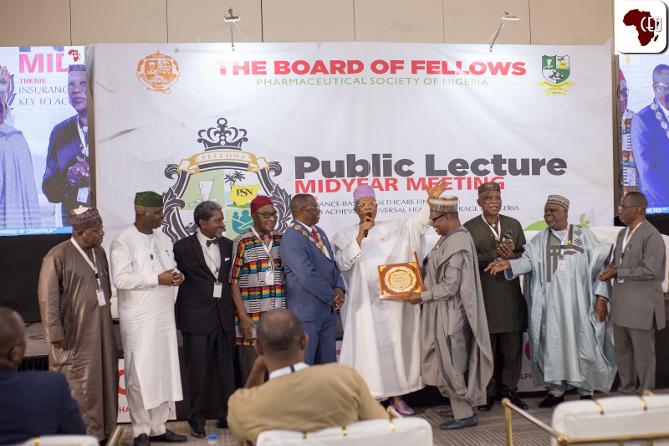
Healthcare experts, policymakers and pharmacy professionals have called for accelerated reforms to Nigeria’s health insurance system, noting broader coverage is essential to protect millions of citizens from exorbitant healthcare costs and advance Universal Health Coverage (UHC).
The appeal was made during the 2026 Public Lecture and Mid-Year Meeting of the Board of Fellows of the Pharmaceutical Society of Nigeria (BOF-PSN) in Lagos, where participants urged governments, employers and private organisations to expand health insurance, especially among workers in the informal sector.
Speaking at the event, Chairman of the Board of Fellows, Pharm. Uchenna Uzoma Apakama, said health insurance coverage in Nigeria remains low, leaving a large proportion of the population to finance medical care through out-of-pocket spending.
“Only about five to eight percent of Nigerians currently have health insurance coverage, leaving millions vulnerable to catastrophic healthcare expenses,” Apakama said.
He described affordable health insurance as a vital component of social protection and national development, urging members of the National Assembly to use part of their constituency intervention funds to sponsor health insurance premiums for vulnerable citizens.
The public lecture, themed “Insurance-Based Healthcare Financing: Key to Achieving Universal Health Coverage in Nigeria,” also highlighted concerns that Nigeria’s Universal Health Coverage index remains around 40 percent, while more than 70 percent of healthcare expenditure is financed directly by households.
Participants encouraged labour unions, transport associations, market groups and community organisations to adopt group health insurance schemes as a practical strategy for expanding access to healthcare.
Former Minister of Health, Prince Julius Adelusi-Adeluyi, urged Nigerians to place greater value on protecting their health through insurance.
“Many people insure their cars and other valuable assets but ignore health insurance until illness creates severe financial hardship. We must begin to insure lives, not just property,” he said.
Representing the Director-General of the National Health Insurance Authority (NHIA), Dr. Kelechi Ohiri, Pharm. Femi Adeoye said healthcare financing remains central to ongoing health sector reforms under the Federal Government’s Renewed Hope Agenda.
He noted that efforts were underway to improve provider accreditation, expand digital solutions and simplify enrolment procedures to increase participation in the health insurance scheme.
Integration
Managing Director and Chief Executive Officer of Hygeia HMO, John Iwuajoku, said more than 130 million Nigerians remain outside the health insurance system due to low awareness, inadequate funding and limited healthcare infrastructure.
He proposed integrating the National Identification Number (NIN) and Bank Verification Number (BVN) into health insurance enrolment to improve planning, transparency and nationwide coverage.
A major highlight of the event was the unveiling of Ultimate Health HMO’s U-Health GIFSHIP (Group, Individual and Family Social Health Insurance Programme), designed to provide affordable health insurance for traders, artisans, transport workers and other participants in the informal economy.
Also, Managing Director of Ultimate Health HMO, Dr. Lekan Ewenla, said the initiative was introduced to reduce the healthcare access gap among uninsured Nigerians.
“Our mission is not only to provide health insurance but also to make quality healthcare more affordable, accessible and equitable for every Nigerian,” Ewenla said.
Representatives of the Pharmacy Council of Nigeria, the National Drug Law Enforcement Agency (NDLEA) and other professional organisations pledged to strengthen collaboration in expanding health insurance coverage and building a sustainable healthcare financing system capable of protecting Nigerians from medical-related poverty.