



The Global Initiative for Food Security and Ecosystem Preservation (GIFSEP), and renewable energy experts have called for a phased approach to local solar panel manufacturing in Nigeria, warning that an immediate import ban could increase equipment prices and undermine access to affordable electricity.
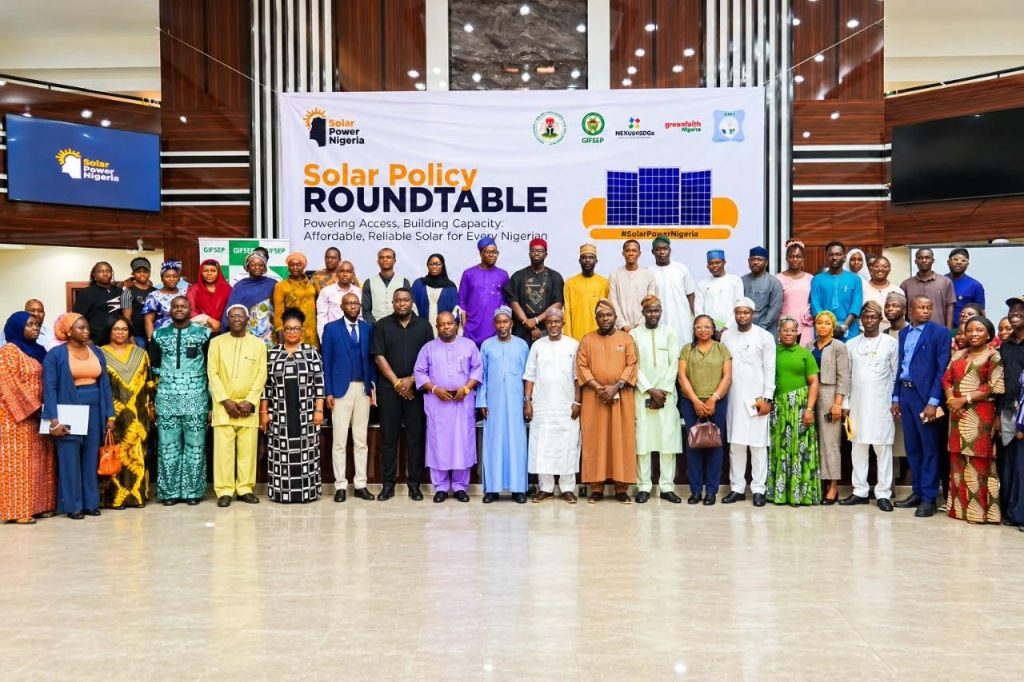
The stakeholders made the call in Abuja at a Solar Policy Roundtable, where they discussed strategies for strengthening Nigeria’s solar industry while protecting consumers and expanding electricity access.
Participants stressed that although local solar manufacturing could create jobs, attract investment and conserve foreign exchange, the government must first address gaps in production capacity, access to finance, raw materials and quality assurance before imposing restrictions on imported solar panels.
In his opening remarks, the Executive Director of GIFSEP and Co-convener of the Solar Power Nigeria Campaign, Dr Michael Terungwa, said Nigeria’s growing solar market presented opportunities to create jobs, develop technical expertise and strengthen domestic manufacturing.
Dr Terungwa said Nigeria imported approximately 2.9 million solar panels in 2025, valued at about ₦435.52 billion, according to foreign trade data from the National Bureau of Statistics.
READ ALSO: Nigeria Partners Foreign Manufacturers to Boost Solar Production
He also cited Nigeria’s position as Africa’s second-largest importer of solar panels, describing the figures as evidence of growing demand and the potential for domestic manufacturers to expand their operations.
However, he warned that market growth alone would not guarantee industrial development unless the country established policies that encouraged local production without compromising affordability, product quality and consumer protection.
Terungwa commended the Minister of Innovation, Science and Technology, Dr Kingsley Udeh, for his position that Nigeria should not prohibit solar panel imports before developing adequate domestic manufacturing capacity.
He argued that an immediate ban could increase prices, slow solar adoption and restrict access to reliable electricity for households and businesses.
According to him, any future import restrictions should be tied to verified domestic production capacity, competitive pricing and effective quality certification.
In its policy brief titled Localisation of Solar Panels and Accessories Production in Nigeria, GIFSEP recommended a three-to-five-year phased transition to domestic manufacturing, with regulated imports maintained until local producers could adequately meet national demand.
The organisation estimated Nigeria’s operational solar module assembly capacity at about 350 megawatts, noting that domestic manufacturers still depend heavily on imported solar cells, specialised glass and other essential components.
The assessment warned that an immediate import ban could increase solar equipment prices by between 15 and 25 per cent, adding at least ₦80,000 to the hardware costs of a household installation requiring four 400-watt solar panels.
According to the report, 80 per cent of industry experts surveyed supported a phased transition, while only 1.5 per cent considered Nigeria ready for an immediate ban. It also indicated that 70.4 per cent of respondents feared a significant reduction in electricity access under an immediate-ban scenario.
GIFSEP warned that restricting imports before domestic manufacturers could meet demand might create supply shortages, disrupt solar installation businesses and encourage the circulation of counterfeit or substandard panels.
To strengthen domestic manufacturing, Dr Terungwa identified skills development, local manufacturing and assembly, and quality assurance as three priority areas requiring government attention.
He called for a national certification pathway for solar technicians, alongside practical training and retraining programmes for generator technicians transitioning into the renewable energy sector.
He also recommended that certified personnel be engaged in publicly funded solar installations to improve safety, service quality and employment opportunities.
On financing, GIFSEP proposed long-term, low-interest loans and credit guarantees to help manufacturers expand production, acquire equipment and improve their competitiveness.
The organisation also recommended tax holidays of three to five years for eligible manufacturers, alongside reduced or zero import duties on selected raw materials and manufacturing equipment.
It proposed possible tariffs of between 10 and 20 per cent on finished imported solar panels as part of a gradual localisation framework, provided consumer affordability and market competitiveness were protected.
GIFSEP further suggested local-content requirements of between 30 and 50 per cent for government-funded electrification projects, subject to domestic manufacturers meeting agreed standards for quality, affordability and supply reliability.
Major Challenges
The policy brief identified inadequate financing, limited technical capacity, unreliable industrial electricity supply, insufficient processing infrastructure and inconsistent quality-control systems as major obstacles to developing a competitive domestic solar industry.
Although Nigeria possesses raw materials relevant to solar equipment production, including silica sand, iron ore, aluminium, lithium and copper, the report noted that gaps in processing infrastructure constrain their effective use in local manufacturing.
GIFSEP also identified opportunities to expand domestic production of batteries, mounting structures, distribution boxes and electrical cables, while noting that advanced inverters and charge controllers remain heavily dependent on imported technology.
The organisation further called for predictable government policies, stronger regulatory coordination, improved testing facilities and compliance with relevant international standards to prevent substandard products from entering the market.
In his welcome address, the Special Assistant to the President on Climate Change Matters, Comrade Yussuf Kelani, said Nigeria must balance the development of a competitive domestic solar industry with the need to ensure affordable and reliable electricity for households, small businesses and underserved communities.
Kelani noted that millions of Nigerians continued to face electricity access and reliability challenges, making renewable energy essential to the country’s economic development, climate ambitions and national resilience.
He stressed that affordability must remain central to energy policy, particularly as Nigeria prepares for changes in electricity pricing and subsidy arrangements from 2027.
The presidential aide identified the Electricity Act 2023, the National Renewable Energy and Energy Efficiency Policy, the Energy Transition Plan and Nigeria’s Nationally Determined Contribution 3.0 as important frameworks for advancing renewable energy.
Also speaking at the roundtable, the Director of the Centre for Renewable Energy and Sustainability Transitions at Bayero University, Kano, Professor Nasir Fagge, called for broader stakeholder consultation before the Federal Government implements restrictions on solar panel imports.
Presenting a policy brief titled Nigeria’s Energy Access Challenge and the Localisation of Solar Panel and Accessories Production, Fagge said manufacturers, investors, energy experts and research institutions should contribute to policy development to ensure that government decisions reflect industry realities and Nigeria’s manufacturing capacity.
He emphasised the importance of developing domestic resources and technical expertise, identifying the country’s mineral resources and renewable energy potential as opportunities for industrial development, job creation and the production of solar components and lithium-ion batteries.

