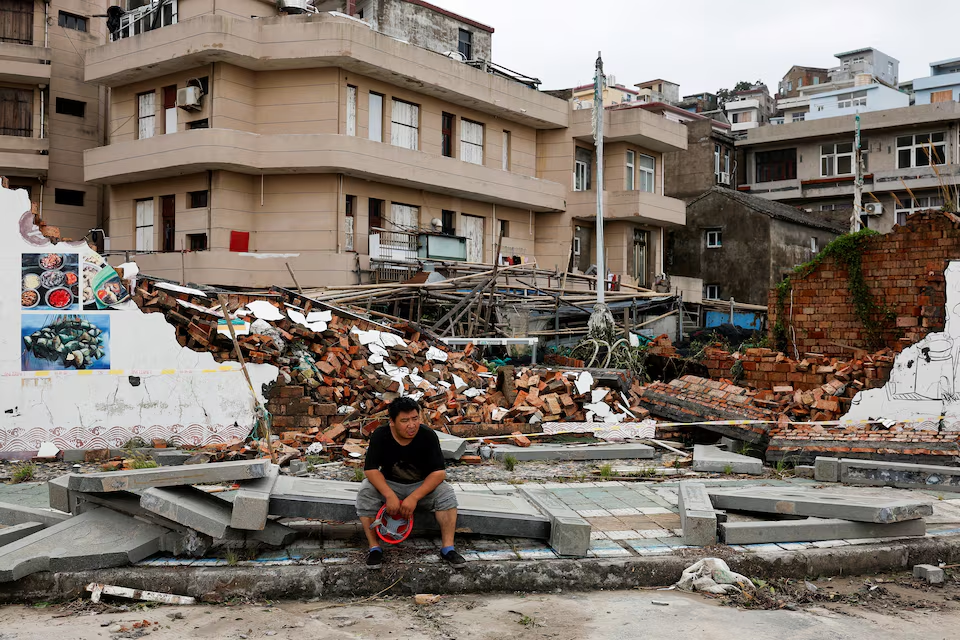
Typhoon Bavi, the strongest storm to hit mainland China this year, battered the country’s eastern coast with torrential rain and powerful winds on Sunday after making landfall in Zhejiang province, forcing more than 2.8 million people to evacuate.
Although Bavi weakened to a tropical storm as it moved inland, forecasters warned its massive circulation could bring days of heavy rain across eastern and northern China, increasing flood risks. More than 2.2 million evacuees were from Zhejiang, while no deaths or injuries had been officially reported.
The storm first struck Yuhuan late Saturday before making a second landfall in Yueqing, where strong winds uprooted more than 700 trees and flooded streets. Emergency crews cleared debris and responded to landslides and rising rivers.
“The winds were very strong,” Yueqing resident Li Liangxing told Reuters. “We could hear roof tiles and tree branches falling. Of course we were scared, but we live by the sea, so we’re used to it.”
Describing the flooding, he added: “There used to be a walkway there, but now it’s underwater.”
In Yuhuan’s coastal town of Kanmen, shop owner Lin Yongjin estimated the storm caused more than 6,000 yuan ($885) in damage.
“After it came ashore, there was nothing we could do. Rainwater poured into the house. We spent the whole night dealing with it and didn’t get to sleep until after 5 a.m.,” he said.
Reflecting on the storm’s intensity, Lin added: “It was a very powerful typhoon. It made landfall right here in Kanmen. We were right in its path.”
The typhoon also disrupted transport across the region. Hundreds of flights and thousands of train services were cancelled in Zhejiang, Shanghai and Taiwan. Taiwan reported 134 injuries but no fatalities after the storm brought heavy rain and strong winds.
READ ALSO: China, Taiwan Brace for Typhoon Bavi
China’s National Meteorological Center said Bavi was expected to move northeast toward the Yellow Sea by Tuesday, with heavy to torrential rain forecast for several provinces.
Climate experts warned that even weakened storms can produce destructive weather far inland. “Rapid intensification (of typhoons) reduces preparation time for communities and emergency managers, making these events particularly challenging,” said Benjamin Horton of the City University of Hong Kong. Scientists also cautioned that the expected El Niño pattern could bring more extreme weather and stronger typhoons to China this year.
Reuters