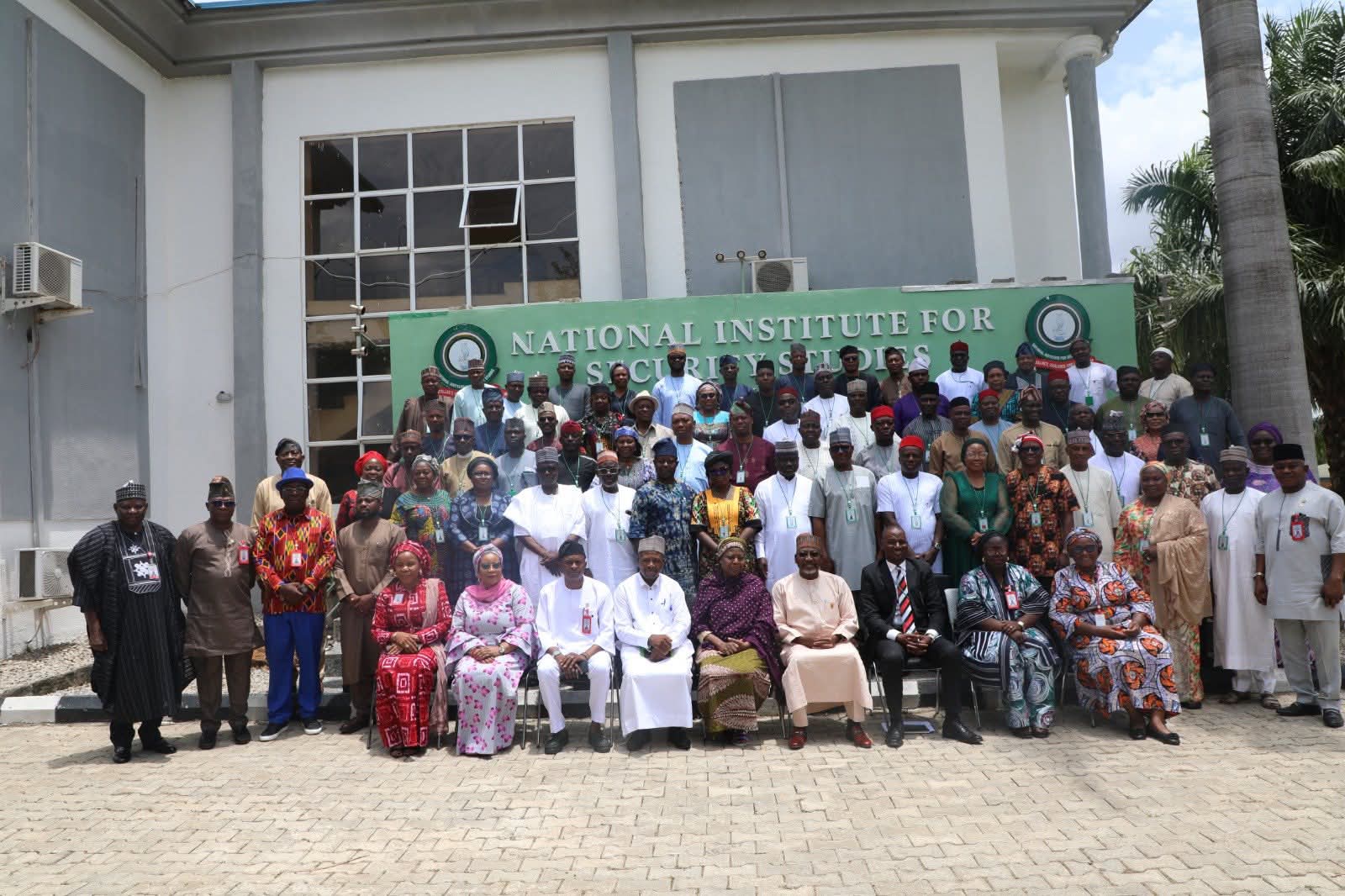
A former spokesman of the Nigerian Army Retired brigadier general Sani Usman Kuka Sheka, has called on African governments to move beyond conventional military responses and adopt intelligence-driven, people-centred frameworks to address rising threats from ethnic militias and competition over scarce resources.

Kuka Sheka, a public relations expert and resource person at the Nigerian Army Resource Centre, made the call while delivering a lecture at the National Institute for Security Studies (NISS) in Abuja.
Lecture Focused on Security Architecture Gaps
Speaking to participants of the Executive Intelligence Management Course (EIMC) 19/2026, Sheka noted that identity-based violence, violent extremism, and disputes over land, water, and mineral deposits are fundamentally reshaping Africa’s security landscape.
His lecture was titled: “Security Architecture Responses to Ethnic Militias and Resource Competition in Africa: Effectiveness and Limitations”.
Militias Have Evolved Beyond Local Defence
According to the security expert, ethnic militias across the Sahel and the Niger Delta have transformed from local self-defence groups into organised non-state actors capable of undermining state authority, destabilising governance structures, and threatening regional security.
“Military operations across the continent have recorded pockets of success in stabilising conflict-prone areas,” Sheka said. “However, many interventions have failed to address deeper structural drivers of insecurity, including governance deficits, social inequality, unemployment, environmental pressures, and the widening trust deficit between governments and local communities.”
Calls for Intelligence-Led, Community-Centred Approach
He argued that Africa’s security challenges can no longer be tackled through kinetic responses alone.
“The future of security lies in intelligence-led, technology-driven, and community-centred approaches,” he said.
“Ethnic militias thrive where governance is weak, justice is absent, and citizens lose confidence in the ability of the state to protect lives and livelihoods.”
Proposes Regional Intelligence Fusion Cells
To strengthen the continent’s security architecture, Sheka proposed the establishment of Regional Intelligence Fusion Cells to facilitate intelligence sharing, monitor transnational militia movements, and enhance early warning mechanisms.
He also called for the use of predictive modelling and data-driven frameworks to anticipate resource-based tensions before they escalate into violence.
Strategic Communication as Core Security Function
The retired brigadier general further stressed that strategic communication should be treated as a core national security function.
According to him, effective communication is needed to counter hostile narratives, combat misinformation, rebuild public trust, and reinforce state legitimacy.
“In the twenty-first century, security is no longer defined only by military strength but by the ability of states to manage information, build public trust, and respond proactively to emerging threats,” he said.
Commends NISS Management, Participants
Sheka commended the Commandant of NISS, Mr. J.O. Odama, the Director of Studies; and the institute’s management for the invitation and hospitality.
He also praised participants of EIMC 19/2026 for their engagement during the interactive session, saying their questions reflected the institute’s academic and professional standards.
The lecture concluded with a call for a security doctrine that integrates development, justice, intelligence and effective communication alongside military operations to ensure long-term stability across Africa.