The European Union (EU), in partnership with the United Nations Children’s Fund (UNICEF), has reaffirmed its commitment to supporting education development in Kano State and across Northern Nigeria, with a strong focus on reducing the number of out-of-school children and improving learning quality.
The commitment was reiterated during a visit by an EU delegation to education projects in Kano State to assess ongoing interventions funded through partnerships aimed at expanding access to education and strengthening learning outcomes.
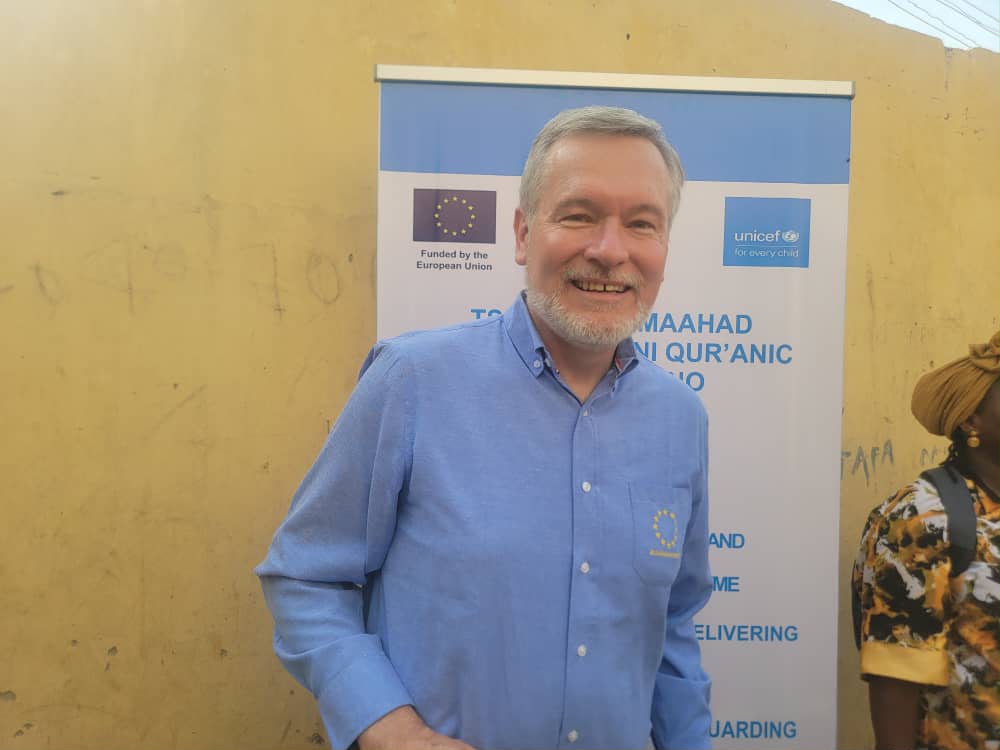
Speaking during the visit, the EU Ambassador to Nigeria and ECOWAS, Gautier Mignot, said education remains one of the bloc’s highest priorities in Nigeria because of its role in promoting development and creating opportunities for children and young people.
READ ALSO: EU, UNICEF Launch Education Support for Displaced Children
“We are visiting some of the projects we are funding in Kano State, and education is one of our top priorities to help out-of-school children integrate into learning,” he explained.
The delegation visited an integrated Qur’anic school supported through UNICEF, where children combine religious studies with literacy and practical subjects, including mathematics and language.
Mignot said Europe’s partnership with Nigeria is driven by longstanding social, historical and cultural ties, noting that investment in education benefits both regions.
“We want West Africa and Nigeria in particular to do well because this will impact favourably on us also. Education is key, especially children’s education and vocational training to foster development,” he stressed.
The Ambassador noted that while expanding access to education remains important, equal attention must be given to maintaining quality standards.
“It is not only about how many schools you build or how many pupils attend, but also about the quality of education provided. We are encouraged to see motivated teachers and children eager to learn,” he added.
The delegation also highlighted support for Technical and Vocational Training (TVT), designed to equip young people with practical skills and employment opportunities.
Speaking during the visit, UNICEF Representative in Nigeria, Wafaa Saeed, said the broader education intervention supported by the EU is expected to reach about 1.2 million children across several states.
“This is not a one-year project. The overall target is to support up to 1.2 million children through different approaches and across different states, not only Kano,” she stated.
Saeed explained that the initiative complements government investment in education rather than replacing it.
“We are looking at models that the Government of Nigeria and the people of Nigeria can replicate using government resources. We understand these classes were built by the state government, and we are here to support government efforts,” she emphasised.
Teachers at the school visited informed the delegation that about 350 pupils are currently enrolled under the integrated learning model.