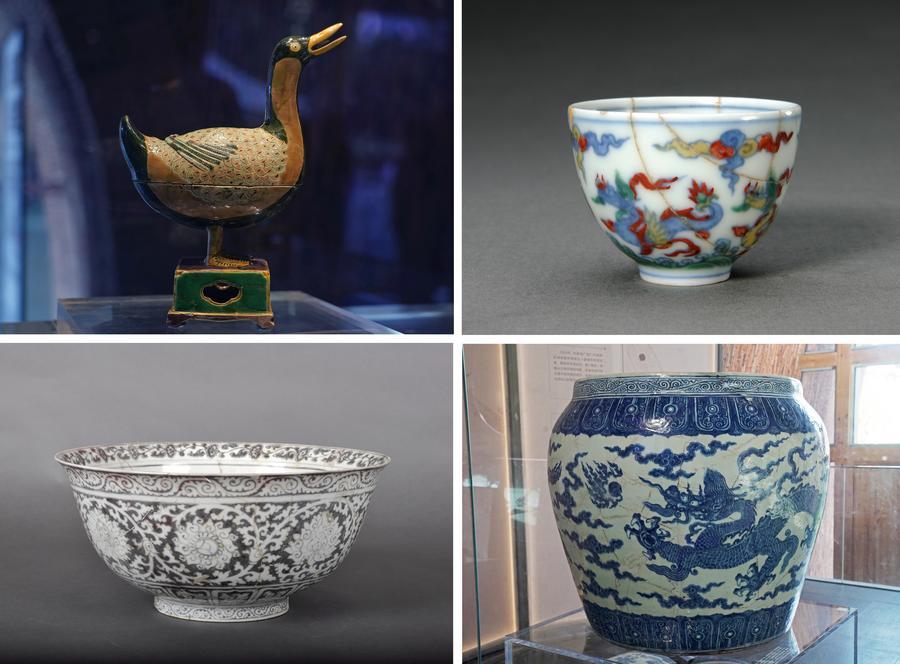
For more than 2,000 years, the kilns of Jingdezhen in eastern China have transformed ordinary clay into exquisite porcelain, carrying Chinese craftsmanship across continents and helping to foster cultural exchanges between civilisations.
The Jingdezhen Handicraft Porcelain Industry Sites were inscribed on the UNESCO World Heritage List, recognising the city’s enduring porcelain-making tradition as an important part of Chinese civilisation.
The inscription also highlights China’s efforts to preserve and revitalise its traditional crafts, an endeavour that has received strong support from Chinese President Xi Jinping.
Preserving a Living Tradition
Porcelain is widely regarded as one of the most distinctive symbols of Chinese civilisation. Xi has repeatedly stressed the importance of protecting cultural heritage while ensuring that traditional culture continues to evolve with the times.
During a visit to Jingdezhen, known as the “Porcelain Capital”, in 2023, Xi visited historic kiln sites, museums and cultural areas to learn about the city’s ceramic heritage. He also met Sun Lixin, a fourth-generation porcelain craftsman.
Admiring Sun’s work, Xi asked whether he painted according to a design or relied on his sense of touch.
Sun replied: “It’s all in my heart.”
Xi observed that devoting one’s entire life to a single craft, with generations of a family pursuing the same tradition, was no simple undertaking.
He said the fine traditional culture inherited from previous generations must be preserved, adapted to the times and carried forward.
Xi’s interest in protecting China’s ceramic heritage dates back to his work in Zhejiang Province in the early 2000s. There, he promoted the preservation of Longquan celadon, another important Chinese ceramic tradition.
A museum was subsequently established, while Longquan celadon firing techniques were inscribed on UNESCO’s Representative List of the Intangible Cultural Heritage of Humanity in 2009.
Xi’s broader cultural heritage efforts have included visits to major historical sites across China and support for their preservation and international recognition.
“Protecting, preserving and making good use of these invaluable treasures is our shared responsibility,” Xi has said, stressing that such efforts are essential to ensuring the continuity of human civilisation and advancing sustainable development worldwide.
Porcelain as a Bridge Between Civilisations
Chinese porcelain has long played an important role in cultural exchange.
Through the ancient Silk Road and maritime trade routes, Chinese vases, bowls and other ceramics travelled to Europe, where they became highly prized in royal courts and among wealthy families.
For Xi, porcelain represents more than artistic craftsmanship. It also serves as a cultural bridge between China and other parts of the world.
He has highlighted Chinese porcelain at international events and during engagements with foreign leaders.
In 2019, while showing foreign leaders a rare blue-and-white vase from the Yuan Dynasty, Xi described the valuable piece as “the panda of ceramics”.
He has also highlighted the influence of international exchanges on ceramic art.
In a 2018 signed article ahead of his visit to Portugal, Xi wrote that China’s blue-and-white porcelain, which was shipped to Portugal centuries ago, inspired a fusion of Chinese and local techniques, giving rise to the distinctive Portuguese art form known as Azulejo.
Architect Jad Tabet has also noted the significant influence of Chinese ceramics on artistic developments in Europe and other parts of the world.
The continuing development of China’s ceramic tradition demonstrates how cultural exchange can promote mutual learning, creativity and shared progress.
As Xi said at UNESCO headquarters, exchanges and mutual learning constitute an important driving force for human progress, global peace and development.
The UNESCO recognition of Jingdezhen therefore celebrates more than an ancient porcelain-making tradition.
It also highlights the enduring role of cultural heritage in connecting civilisations, encouraging mutual understanding and demonstrating how exchanges between different cultures can contribute to human progress.
Xinhua