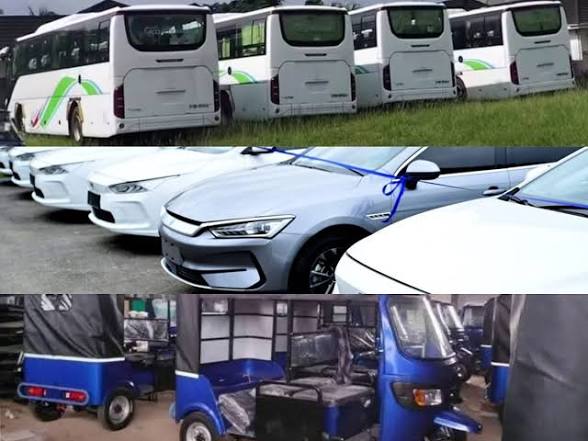
The Cross River State Government says its electric mobility initiative is designed to reduce transportation costs, improve public commuting and create new economic opportunities for residents as part of efforts to modernise the state’s transport sector.
The Commissioner for Transport, Mr Ekpenyong Cobham, disclosed this while interacting with journalists in Calabar, the Cross River State capital.
Cobham said the initiative was conceived as part of strategies to address the rising cost of petrol and advance the state’s green economy vision of positioning Cross River as Nigeria’s “Eco Capital”.
He said it had become imperative for the government to reduce transportation costs while addressing environmental concerns through cleaner energy solutions.
“It was imperative that we reduce the cost of transportation and address the issue of carbon emissions. Cross River State has a green economy vision, which is to position our dear state as the Eco Capital of Nigeria. We therefore settled for the electric option,” Cobham said.
Electric Vehicles
According to the commissioner, the state has acquired 10 electric inter-city buses, each with a capacity of about 50 passengers, 20 shuttle buses, 500 electric tricycles and 200 electric motorcycles to improve mobility across the three senatorial districts.
He described the investment as “the foundation that will usher in a new era in the state’s transportation ecosystem,” noting that reliance on fossil fuels had become unsustainable due to fluctuating fuel prices.
Cobham said the initiative is expected to significantly reduce transport fares for civil servants and other commuters. He explained that a trip currently costing about ₦600 between Eight Miles and Watt Market in Calabar could fall to between ₦150 and ₦200 once the electric transport system becomes operational.
“We want to give public servants and daily commuters average savings of between ₦300 and ₦400 every day. It is sustainable because we are not buying fuel,” he said.
He added that the electric buses can travel up to 250 kilometres on a single battery charge.
Supporting Infrastructure
The commissioner said the government was finalising contractual arrangements with preferred bidders for the installation of charging stations and other supporting infrastructure required for the operation of the electric vehicles.
Speaking on efforts to improve transportation across local government areas, Cobham said the state remained committed to the Grand Littoral Rail Project, explaining that implementation had been delayed by the federal approval process.
“The Grand Littoral Rail Project is slightly behind schedule, not because of anything at the state level, but due to federal bottlenecks in obtaining the necessary approvals. We are, however, on the verge of resolving the outstanding issues,” he said.
He also disclosed that the State Executive Council had approved a Special Purpose Vehicle (SPV) to drive the rail project, adding that construction would commence once all outstanding approvals were secured.
Economic Benefits
Beyond improving transportation, Cobham said the initiative would stimulate economic growth by creating jobs and increasing the earnings of transport operators.
“Any beneficiary of the electric tricycles will earn not less than ₦15,000 daily. A new, sustainable economy is being created to empower the people of Cross River State,” he stated.
He added that the government was also considering proposals for new inter-city shuttle services and plans to construct a 4,000-capacity trailer park along the Odukpani–Akamkpa corridor to decongest traffic in Calabar and improve the efficiency of the state’s transport network.