
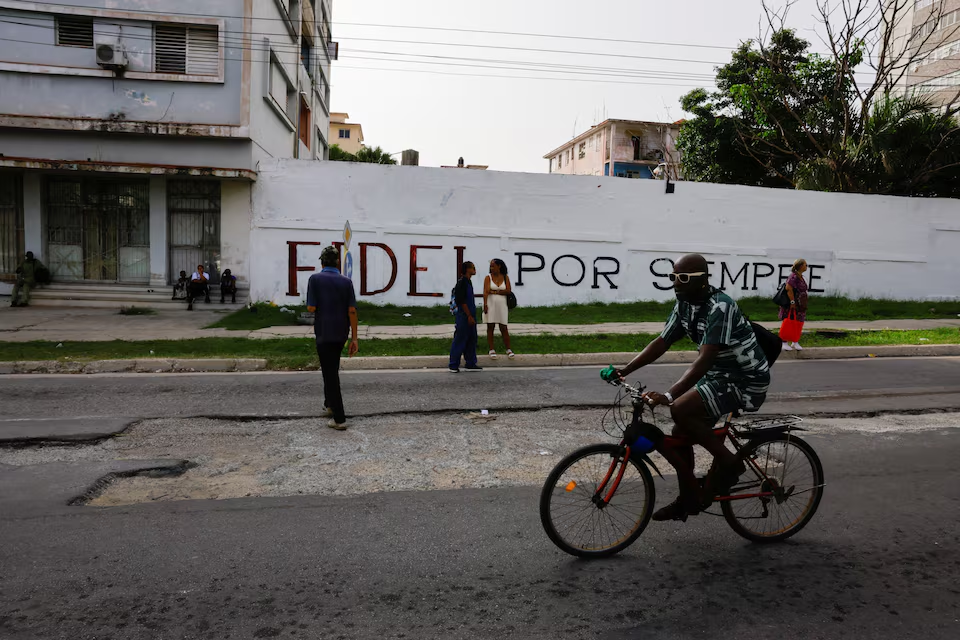
Cuba on Thursday commemorated the 100th anniversary of the birth of revolutionary leader Fidel Castro, as the island faces one of the most severe economic and political crises in its history, intensified by Washington’s oil embargo and tougher sanctions.
More than 1,500 activists and representatives from solidarity organisations in over 60 countries across Latin America, Europe, Africa and Asia travelled to Cuba this week for events marking Castro’s legacy, according to the Cuban government.
“Fidel’s legacy speaks to us today with greater force than ever,” Cuban President Miguel Diaz-Canel said at Monday’s opening of an international conference dedicated to Castro’s legacy.
Diaz-Canel stressed that it was important to remember Castro not only as a historical figure but also “as a guide for overcoming the challenges before us today, in the real Cuba of 2026.”
The anniversary is being observed as relations between Havana and Washington grow increasingly tense. In January, U.S. President Donald Trump’s administration imposed an oil embargo on Cuba in an effort to pressure the Cuban government. Washington has also tightened sanctions, which Havana describes as an unprecedented effort to cripple the country’s finances and operations.
The impact of the U.S. policy has been felt across the island. Power outages lasting more than 20 hours a day in most provinces have disrupted food production, transportation and tourism, bringing Cuba’s national electricity system close to technical collapse. The power grid experienced three nationwide failures in July alone.
Amid the worsening crisis, the Cuban government approved a package of 176 measures in June designed to open the country’s socialist economy further to private and foreign investment.
If fully implemented, the reforms would mark an unprecedented move toward free-market capitalism, standing in sharp contrast to the socialist economic model that defined Castro’s rule for decades.
READ ALSO: Nigeria Reaffirms Diplomatic Ties with Cuba
Some changes are already taking place. In the energy sector, for instance, U.S. fuel exports to private Cuban businesses have surged this year, contributing to the expansion of a chaotic black market while widening social and economic inequality.
NOSTALGIA
For some Havana residents, the economic hardship and political uncertainty have fuelled renewed nostalgia for Castro’s leadership.
“At a moment of crisis like this, he might have had other solutions that today we simply do not have,” said Benito Cisneros, 62.
Castro was born in the eastern province of Holguin on August 13, 1926. As the leader of the 1959 Cuban revolution, he went on to become one of the most influential figures on the international left.
A decade after his death, his legacy remains deeply embedded in Cuba’s national narrative.
However, Fabio Fernandez, a history professor at the University of Havana, argued that many of those now responsible for governing the country have failed to live up to Castro’s example.
“Invoking him is an attempt to sustain consensus,” Fernandez said.
“But when you talk to people in the street, something very evident emerges: many believe that if Fidel were still leading the country’s destiny, Cuba would be a different country.”
Reuters

