The Nigerian government on Monday stressed that the present administration’s reforms may have been painful on citizens but insisted they were necessary to save the nation’s economy from total collapse.
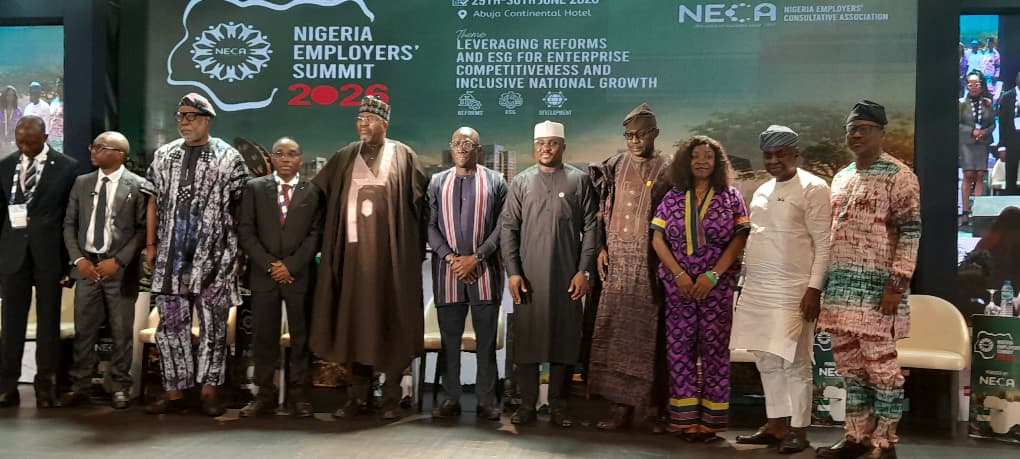
Vice President Senator Kashim Shettima stated this on Monday in Abuja at the opening of a two-day “Nigeria Employers’ Summit 2026” holding in Abuja, Nigeria’s capital.
The Summit, in its 5th series, was organised by the Nigeria Employers Consultative Association NECA with the theme “Leveraging Reforms and ESG for Enterprise Competitiveness and Inclusive National Growth”.
Represented by the Special Adviser, General Duties to the President, Office of the Vice President, Dr Aliyu Modibo-Umar, the Vice President said that the nation’s economy was in very bad shape when the present administration assumed office three years ago.
“When His Excellency, President Bola Ahmed Tinubu, GCFR, assumed office, the economy carried deep structural burdens.
“Fuel subsidies had become fiscally unsustainable. The foreign exchange market was fragmented, government revenue was weak and investor confidence required rebuilding.
“The Renewed Hope Agenda was designed to confront these realities. We cannot build prosperity on distortions, attract investment when foreign exchange remains uncertain, or create jobs when enterprises are suffocated by multiple taxation, poor logistics and insecurity.
“The reforms have been difficult, but their purpose is to correct the foundations so that growth becomes real, durable and inclusive,” he stated.
He disclosed that restoring macroeconomic stability was one of the first tasks of the government because according to him, a stable economy is the first infrastructure of business.
“Before roads, railways and ports, businesses need confidence to plan and invest.
“This is why removing the fuel subsidy and reforming the foreign exchange market remain central to our reforms.
“The subsidy crowded out investment while encouraging inefficiency and rent-seeking. The foreign exchange reforms are delivering a more transparent and market-reflective system.
“Our fiscal and tax reforms follow the same logic. Businesses do not reject taxation. They reject multiple taxation, harassment and systems that punish compliance while rewarding informality.
“Our agenda reduces the number of taxes, harmonises administration, protects the vulnerable, supports small businesses and encourages compliance by lowering rates while widening the tax base needed to fund infrastructure,” Shettima said.
He stated that the reforms in the power sector, gas development, debt management, the Presidential CNG Initiative and the broader energy transition serve one purpose, which is to reduce the energy burden on businesses and households.
According to him, “Compressed Natural Gas allows us to utilise our domestic resources to reduce transportation costs, support cleaner mobility and attract investment.
“As production becomes cheaper and more reliable, jobs follow, incomes improve and demand rises. That is how economies grow from within.”
Speaking on the opportunities provided by the continent, Senator Kashim Shettima lauded the African Continental Free Trade Area, saying it presents enormous opportunities, but those opportunities are not automatic.
He said Nigeria must participate as a producer and exporter, not merely as a market for the products of others.
“The private sector asks only that government should not make doing business unnecessarily difficult. Every delayed approval and every unclear regulation imposes additional costs on enterprises.
“That is why we remain committed to reducing bottlenecks and digitising government processes so that reforms announced in Abuja are experienced by businesses in Lagos, Kano, Aba and every part of the country without delay,” he said.
The Vice President also spoke on our security and food production, which he said also continues so businesses can operate without fear and farmers can safely return to their fields.
Speaking on the overview of the two-day summit, Director General, NECA, Mr Adewale-Smart Oyerinde, said the summit was born five years ago with the belief that it was important for employers to come together, not only within existing consultative structures, but also to share their perspectives on the economy and identify policies that would enable the private sector to fulfil its role as the engine of national development.
He recalled that the NECA Employers’ Summit that began five years ago recognised the strength of the over 35 sectoral employer groups, representing industries such as construction, food and beverages, chemicals and non-metallic products, iron and steel, commerce, distribution and many others.
Five years later, we are proud that this summit has consistently produced practical policy recommendations that successive governments have found useful.
“One of the key recommendations consistently made by the organised private sector over the years was the removal of the fuel subsidy.
“Every Annual General Meeting addressed by successive Presidents of NECA reinforced that position.
“Today, the subsidy has been removed, and we are all living with the realities of that decision,” he said.
Oyerinde said the summit has shaped national conversations and strengthened confidence between government and the organised private sector.
The organised private sector, he said, understands the reality of government’s reforms in different sectors of the nation’s economy. “Our responsibility is to ensure that government also understands where businesses are experiencing challenges and what policy adjustments are required to improve enterprise competitiveness.
“This summit provides that platform. It ensures that the voice of employers is heard and that policies are informed by practical business realities,” he said.