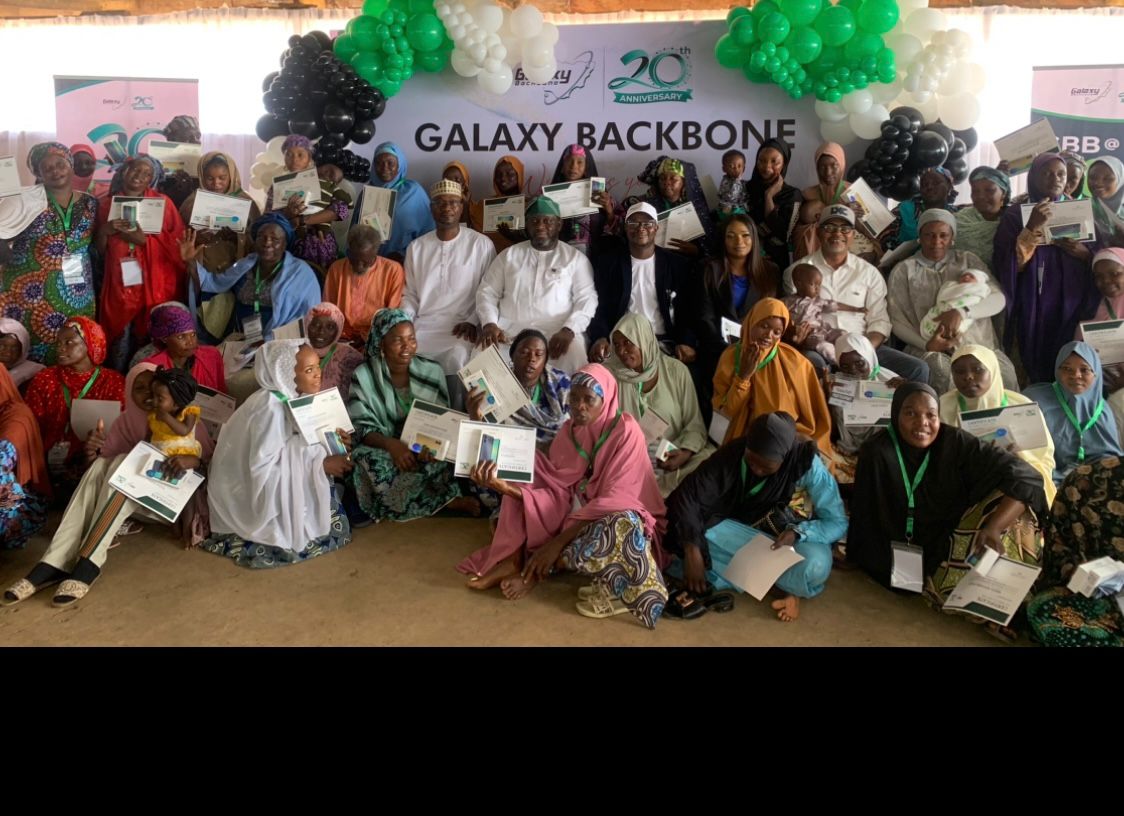
Galaxy Backbone Limited (GBB) has launched a digital livelihood empowerment initiative for internally displaced persons (IDPs) at the Durumi IDP Camp in Abuja, marking a significant milestone in the company’s 20th anniversary celebrations.
Speaking at the event, the Managing Director and Chief Executive Officer of Galaxy Backbone, Professor Ibrahim Adeyanju, said the initiative reflects the company’s commitment to ensuring that technology serves as a tool for social and economic transformation, particularly for vulnerable communities.
According to Adeyanju, Galaxy Backbone’s 20-year journey has been defined by innovation, resilience, and service in connecting communities, building digital infrastructure, and driving national development. However, he stressed that true connectivity goes beyond broadband networks and digital infrastructure.
“True connectivity is about connecting people to opportunity, hope, and a dignified future. That is why we are celebrating our 20th anniversary here today by launching what we consider the most meaningful initiative in our company’s history.”
Adeyanju noted that the growing challenge of internal displacement in Nigeria is not merely a statistical issue but a humanitarian concern affecting thousands of families, particularly women and young people who continue to demonstrate resilience despite losing their homes and livelihoods.
He said Galaxy Backbone aims to change the traditional narrative surrounding internally displaced persons by moving from dependency-driven interventions to sustainable empowerment.
“For too long, the narrative around internally displaced persons has been one of charity and dependency. Today, we are changing that narrative. We are moving from relief to resilience and from handouts to digital tools that can create sustainable livelihoods,” he stated.
Explaining the rationale behind the initiative, Adeyanju said digital technology has become indispensable in modern economic life.
“In the 21st century, a smartphone is not a luxury; it is a marketplace. A laptop is not merely a gadget; it is a classroom, a bank, and a shopfront. Digital literacy is no longer optional. It is the foundation of income-generating opportunities,” he said.
The programme is built around three major pillars: digital skills and capacity building, provision of digital starter toolkits, and market access with mentorship support.
Under the first pillar, beneficiaries underwent practical training in market-relevant digital skills, including digital marketing, social media management, graphic design, content creation, data entry, and virtual assistance.
Adeyanju emphasised that the curriculum was designed to equip participants with skills capable of generating income immediately.
The second pillar focuses on equipping participants with the tools required to apply their newly acquired skills. Beneficiaries received smartphones preloaded with productivity and learning applications, alongside subsidised internet data packages to ensure continuous access to digital opportunities.
The third and most critical pillar, according to the GBB Managing Director, is market integration and mentorship. He explained that Galaxy Backbone staff members would volunteer as mentors to provide ongoing guidance and coaching. The company also pledged to integrate trained beneficiaries into its supply chain and, where possible, become one of their first clients.
“We will not just train you and give you tools. We will ensure you have access to markets and mentorship. Our doors remain open, and we are committed to supporting your journey towards financial independence,” Adeyanju said.
He called on government agencies, private sector organisations, and international development partners to support and replicate similar initiatives aimed at empowering displaced populations.
“The government alone cannot do it all. We need stronger partnerships with the private sector and the international community to connect this growing pool of digital talent to opportunities within the global gig economy,” he emphasised.
Addressing the beneficiaries directly, Adeyanju described the initiative as an investment in their future rather than a response to their losses.
“We do not see victims. We see future CEOs, designers, digital professionals, and entrepreneurs. The tools and skills provided today are the building blocks for new digital homes that no crisis can destroy,” he said.
One of the beneficiaries, Mrs Liyatu Ayuba, said the programme had fundamentally changed her perception of technology and economic opportunities.
“Today is my happiest day since coming to this camp. Before now, I only used my phone to make calls and communicate with family and friends. I never imagined that I could use it to make money.”
She recounted how she applied lessons from the training by promoting a food business through her phone. After advertising a special meal she prepared, she began receiving enquiries from potential customers.
“When people started asking for my location so they could buy from me, I was surprised and excited. Now I want to take it seriously. I want to open a shop, create a banner, and grow the business,” she said.
Ayuba praised Galaxy Backbone for focusing on skills development rather than short-term assistance.
“People have given us food and clothes before, but they did not give us experience or knowledge. Instead of giving someone fish every day, it is better to teach them how to catch fish. This programme has shown us how to build a future for ourselves.”
She expressed confidence that the knowledge gained would not only improve her life but also benefit her children and other residents of the camp.
Beyond training, beneficiaries were also provided with smartphones preloaded with productivity and learning applications, alongside subsidised internet data packages to ensure that connectivity does not become a barrier to applying their newly acquired skills.
The digital livelihood empowerment initiative is expected to provide internally displaced persons with practical pathways to economic self-reliance while strengthening their participation in Nigeria’s growing digital economy.