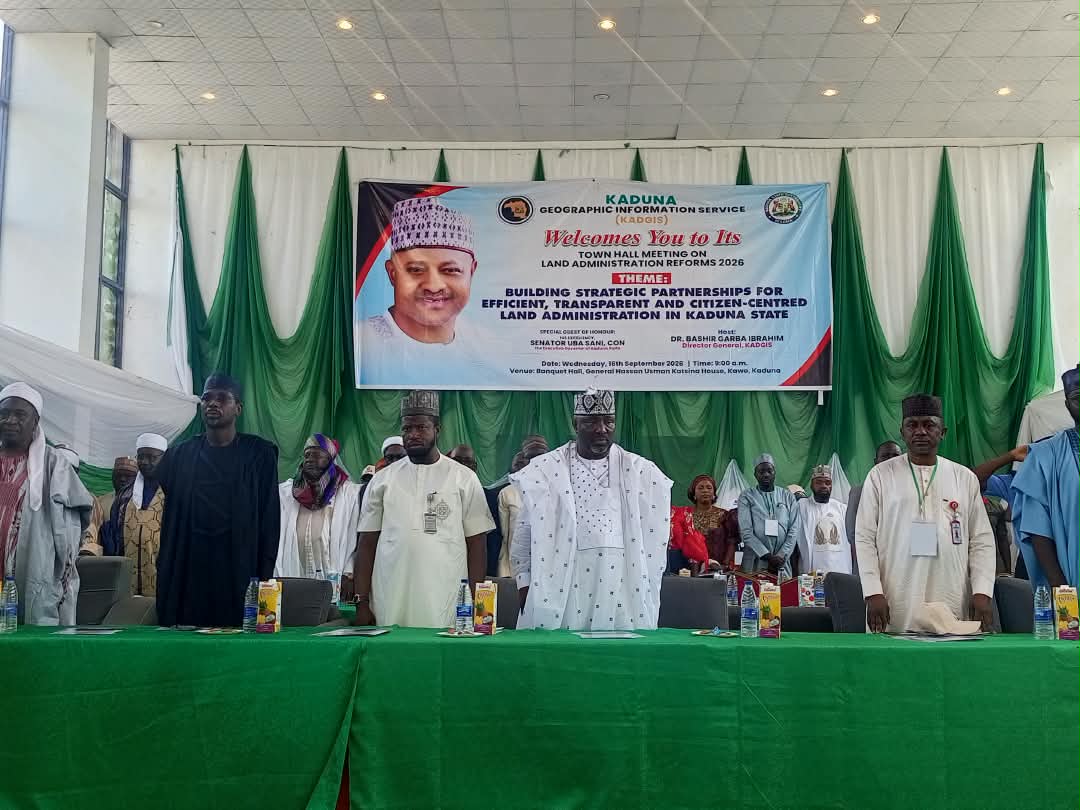
The Kaduna State Geographic Information Service (KADGIS) says it will introduce a registration system for land agents to strengthen accountability and curb property-related fraud in the state.
The Director-General of KADGIS, Bashir Ibrahim, disclosed this in Kaduna at a town hall meeting on Land Administration Reforms 2026.
Ibrahim said the new system would require every land agent operating in Kaduna to obtain a unique, non-transferable agent code.
He explained that the code would enable KADGIS to identify agents responsible for land transactions and establish accountability whenever disputes or fraudulent activities arise.
READ ALSO: Nigeria Advances Land Reforms To Boost Affordable Housing Access
“Every agent must obtain an agent code. If any issue arises, we will know exactly which agent handled the transaction,” he said.
The DG said agents would also be required to register their sub-agents and staff under their codes to ensure accountability for transactions handled on their behalf.
According to him, the registration would cover individual land agents and companies operating in the state.
Ibrahim said the system would also address cases where fraudsters impersonated legitimate land agents to sell properties or forge land documents.
“Some land agents had previously been implicated in investigations despite not being responsible for transactions carried out using their identities,” he stated.
He explained that the registration system would enable KADGIS and law enforcement agencies to trace transactions and distinguish genuine agents from impersonators.
Ibrahim said KADGIS had also strengthened its dispute-resolution mechanism by conducting preliminary investigations before referring land-related complaints to the Economic and Financial Crimes Commission (EFCC).
“The approach had helped reduce unnecessary investigations involving people whose names were wrongly connected to land transactions,” the DG noted
According to him, KADGIS now invites land agents, buyers and disputing property owners to reconciliation meetings to resolve cases before resorting to litigation or law enforcement.
He said more than 3,600 land disputes had been resolved through the mechanism, including cases involving agents, security agencies and courts.
“KADGIS had allocated alternative plots in appropriate cases to resolve disputes where parties were found to have been victims of misunderstandings or improper transactions,” he said.
He said the agency had also reduced the burden on the EFCC and the Independent Corrupt Practices and Other Related Offences Commission (ICPC) through document verification and internal dispute resolution.
“Only when there is financial fraud will the EFCC take over and deal with the client,” he stressed.
The KADGIS boss said the agency had secured and standardised land documentation, introduced National Identification Number (NIN) and Bank Verification Number (BVN) verification, and improved document security.
He said unencumbered plots could now receive Certificates of Occupancy within 72 hours under the reforms.
Ibrahim said KADGIS had reduced its operational workflow from 36 steps to seven, eliminating unnecessary movement of documents between officers.
He said the agency had also established a Quality Assurance Department to verify the authenticity and quality of submitted documents before approval.
The DG said KADGIS had successfully issued 15,379 signed Certificates of Occupancy as part of its reforms.