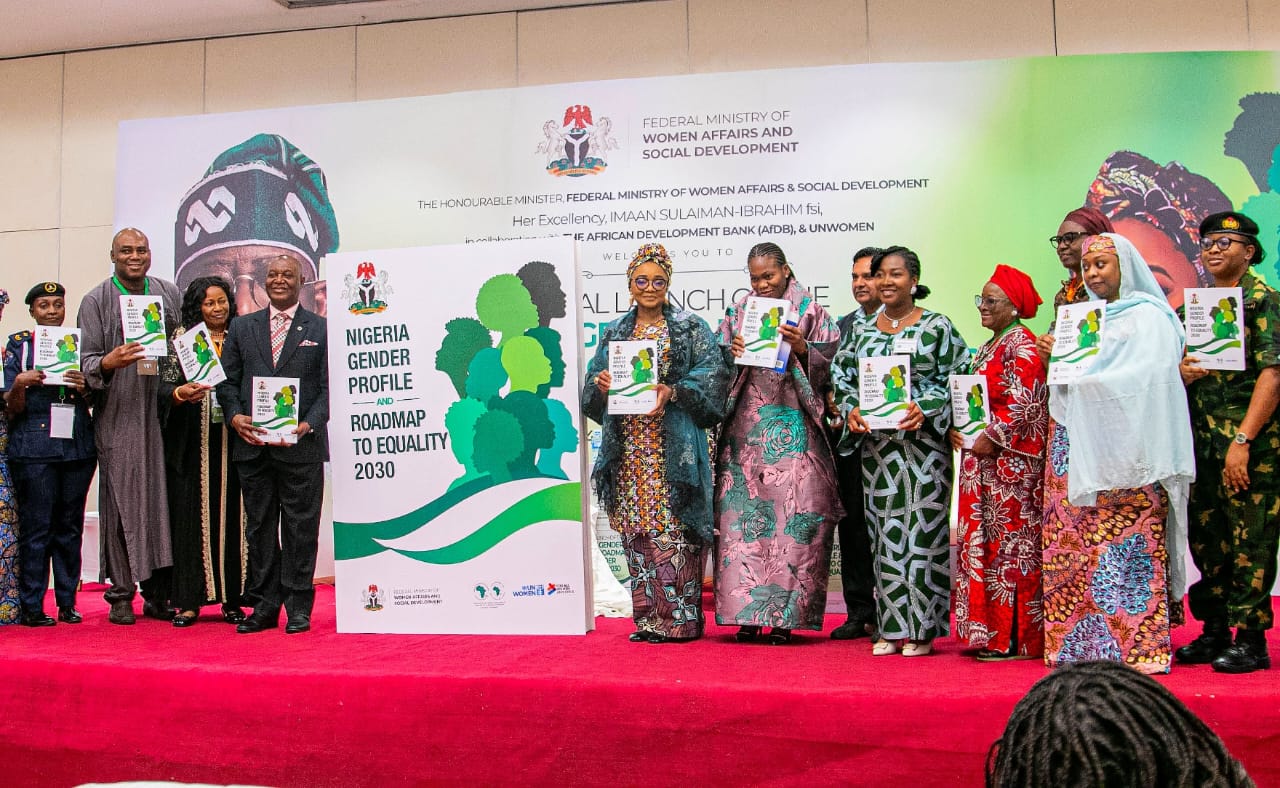
The Nigerian Government, has collaborated with the African Development Bank and UN Women to launch the Nigeria Gender Profile and Roadmap to Equality 2030, a comprehensive policy instrument aimed at accelerating gender parity through evidence-based planning, institutional reform, and measurable targets across key sectors of national development.
Unveiling the framework in Abuja, the Minister of Women Affairs and Social Development, Hajiya Imaan Sulaiman-Ibrahim, said it is both a diagnostic and implementation tool, anchored on eight priority areas, including institutional strengthening, legal reform, economic empowerment, education, leadership, health, climate response, and social norms transformation.
She stated that the initiative is backed by complementary national instruments and sectoral frameworks, stating that its strength lies in translating policy into outcomes.
She stressed that the roadmap is operationalised through the National Gender Policy, the Women’s Economic Empowerment Policy, and 38 validated sectoral frameworks designed to ensure implementation across government institutions because “Gender equality is not a concession; it is a sound investment in the strength of our nation.”
The Minister further highlighted progress under national interventions, including the Renewed Hope Social Impact Interventions and the Women, Peace and Security agenda, noting that implementation structures such as gender desks across ministries are already strengthening accountability; “This is not a task for one Ministry alone.”
She also cited ongoing reforms including affirmative procurement policies and expanded social investment programmes aimed at improving women’s participation in economic and governance systems, emphasising that the roadmap is intended as a “living framework” guiding national development planning towards 2030.
Speaking, the Acting Vice President of the African Development Bank Group, Dr Abdul Kamara, commended the initiative as a strategic bridge between policy formulation and operational delivery.
He noted that gender equality is central to economic transformation, arguing that inclusive growth depends on removing structural barriers affecting women’s access to finance, land, technology, and markets, as “Nigeria cannot afford to leave half of its population behind.”
While pointing out that evidence shows that “closing gender gaps could unlock 2% to 3% of GDP annually”, a transformational figure for Nigeria’s economic trajectory, he emphasised that the Bank’s interventions, including financing for women-led enterprises, skills development programmes, and infrastructure investments, are designed to mainstream gender outcomes across its portfolio.
Kamara urged that implementation, not policy articulation, remains the decisive factor in achieving impact, stressing that “The challenge is no longer about commitments; it is about implementation at scale.”
Representing UN Women, Mr Damar Ghimire described the roadmap as a strategic instrument to advance inclusive growth and accelerate progress towards the Sustainable Development Goals, while highlighting Nigeria’s demographic potential and warning that persistent inequalities continue to constrain national development outcomes.
He said, “Nigeria is home to one of the largest and youngest populations in the world, creating extraordinary opportunities for transformation,” even as “women remain concentrated in lower-income and informal sectors despite their significant contribution to economic activity” and representation in leadership remains at “only 4 percent.”
He said the roadmap “is not a roadmap for the Ministry of Women Affairs alone. It is a roadmap for all ministries, embodying a whole-of-government and multi-sector framework and calling for accelerated implementation towards 2030 outcomes.
Reaffirming gender equality as central to national development, Ghimire stressed that “gender equality is not a standalone agenda; it is the thread that runs across economic transformations, democratic governance, human capital development, climate resilience, and sustainable peace.”
He also renewed UN Women’s commitment to ensuring that “commitment to women and girls move beyond aspiration and become institutional reality.”
Representing the World Bank, Mr Michael Ilesanmi said Nigeria’s development progress cannot be achieved without the full inclusion of women, stating that “there is no way we can ever reach the altitude of the speed if we leave behind half of the country’s population.”
He stressed the needed alignment with government-led priorities, including women’s economic empowerment, human capital development, girls’ education, and improved access to finance and markets.
“What they want is an equal playing field. When we invest in women’s economic empowerment, when we invest in gender equality, when we invest in girls’ education, the whole country benefits.” Ilesanmi said.
He reaffirmed the institution’s commitment to gender equality investments, calling for stronger collective action across all stakeholders. “This is something that we care about, and we will invest in it. No one can do this alone, not the banks, not the UN, not the development partners.”
Also, the Small and Medium Enterprises Development Agency of Nigeria (SMEDAN), through its Director General Charles Odi, reaffirmed commitment to strengthening women-led enterprises as a key driver of inclusive economic growth in Nigeria.
He disclosed that “there are approximately 39,654,385 nano, micro, small and medium enterprises in Nigeria today, 70% of those entrepreneurs are women-owned and women-led.”
He said this reality informed the establishment of a dedicated women’s desk within SMEDAN to enhance targeted support across enterprise categories, alongside incubation, acceleration, and improved access to finance.
He further outlined SMEDAN’s revised enterprise classification system: “If you’re not making more than 3 million Naira annually, and you don’t have more than 3 entrepreneurs, you’re a nano-business. If you don’t have more than 10 employees and you’re not doing more than 25 million Naira annually, you’re a micro-business. Medium enterprises earn between ₦100 million and ₦1 billion annually and employ up to 200 persons.”
Odi also displayed federal support measures for 30 nano-enterprises, announcing, “For those who are nano-businesses, we will give each and every one of you 50,000 Naira each to add to your business,” urging greater uptake of such initiatives.
In a “Nigeria 2030 Equality Roadmap” presentation, Special Assistant to the Minister on Strategy, Mr Mike Imafidor, emphasised the importance of scaling interventions and strengthening implementation frameworks across sectors.
He noted that while progress has been recorded in financial inclusion and social programmes, the priority remains delivery at scale.
Highlighting reforms, he stated, “Recently, Mr President approved the gender-affirmative procurement. It means that more women-owned businesses will be able to participate in procurement activities. We need to strengthen the implementation. We need to look at loss and see how we can reform. We need to also ensure that we’re able to.”
The launch marks a renewed national commitment to embedding gender equality within Nigeria’s development architecture, with stakeholders urging coordinated action across government, development partners, and the private sector to translate policy into measurable outcomes by 2030.