

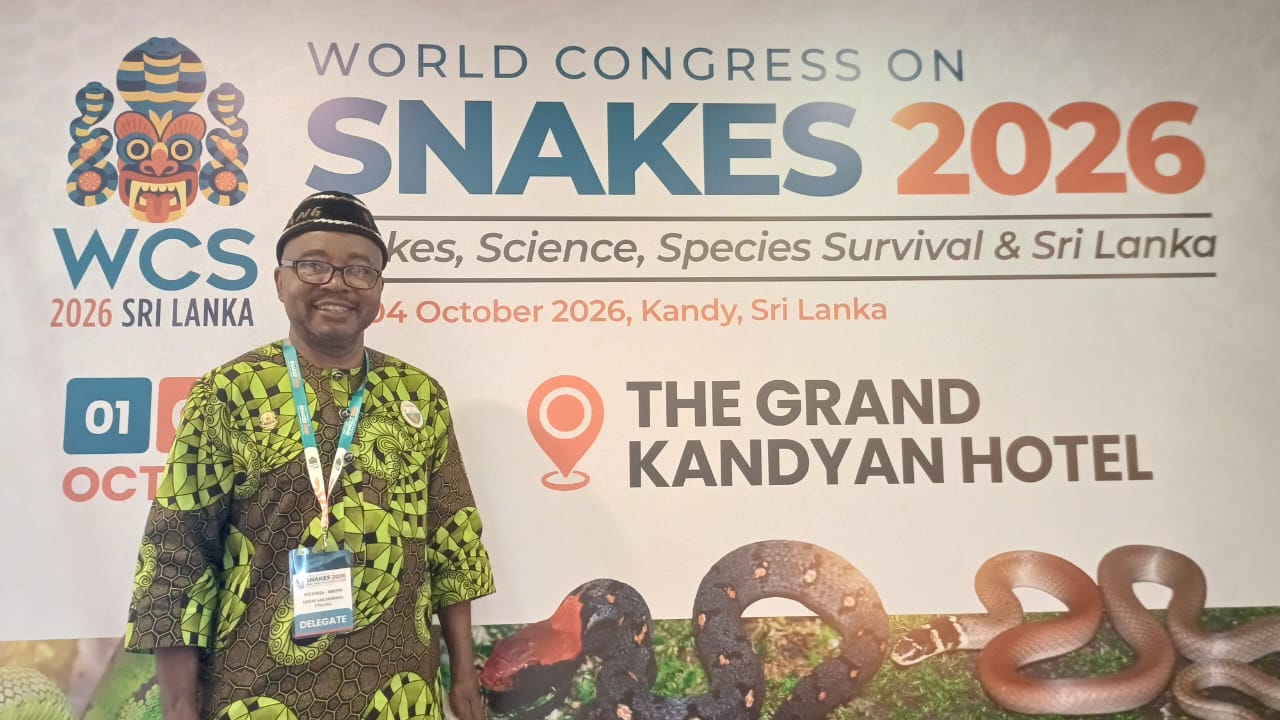
Nigerian conservationist Prof. Edem Archibong Eniang is representing Nigeria at the inaugural World Congress on Snakes (WCS 2026) in Kandy, Sri Lanka, as more than 500 researchers, ophiologists and medical experts from 25 countries gather for the four-day event.
Prof. Eniang, Executive Director of the Biodiversity Preservation Centre (BPC) and Professor of Wildlife Resources Management at the University of Uyo, Akwa Ibom State, South South Nigeria, is Nigeria’s sole representative at the congress, according to Dr. Piriye Kiyaramo, Chairman of the BRACED Tourism Promotion and Development Initiative (BTPDI) and Convener of the Africa Blue Economy Roundtable (ABER).
Dr. Kiyaramo congratulated Prof. Eniang, describing him as a distinguished conservationist who has devoted more than three decades to herpetology, primate conservation and the protection of endangered species.
ALSO READ: Nigeria Establishes National Snakebite Centre, ₦73.9bn for Health Commodities
He said Prof. Eniang’s participation as a BTPDI board member was a source of pride to Akwa Ibom State, the Niger Delta and Nigeria.
The congress is scheduled for October 1–4, 2026, at the Grand Kandyan Hotel. Organisers describe it as the first international conference dedicated entirely to snake biology, conservation and public health.
They say it brings together more than 300 international scientists and over 100 local researchers.
The programme features plenaries, symposia, workshops and field excursions across 12 thematic areas, including snake biology and evolution, human-snake coexistence, snakebite management and toxicology, conservation genomics, artificial intelligence and citizen science, and climate change challenges.
Citing organisers, Dr. Kiyaramo said Sri Lanka was chosen for its extraordinary reptilian diversity.
The island nation is home to 112 snake species, with more than 56 percent endemic.
Congress Chair Prof. Anslem de Silva said the event would establish Sri Lanka as the epicentre of global snake research and conservation policy.
Snakebite envenoming, a neglected tropical disease, causes between 81,000 and 138,000 deaths annually, according to the World Health Organization.
Dr. Kiyaramo said Prof. Eniang’s participation highlights the role of African expertise in addressing the crisis.


 in Kand..)