The Nigerian government has developed national occupational standards and a practical-focused agricultural training model aimed at advancing agriculture as a skills-based sector and equipping young people with industry-relevant competencies.
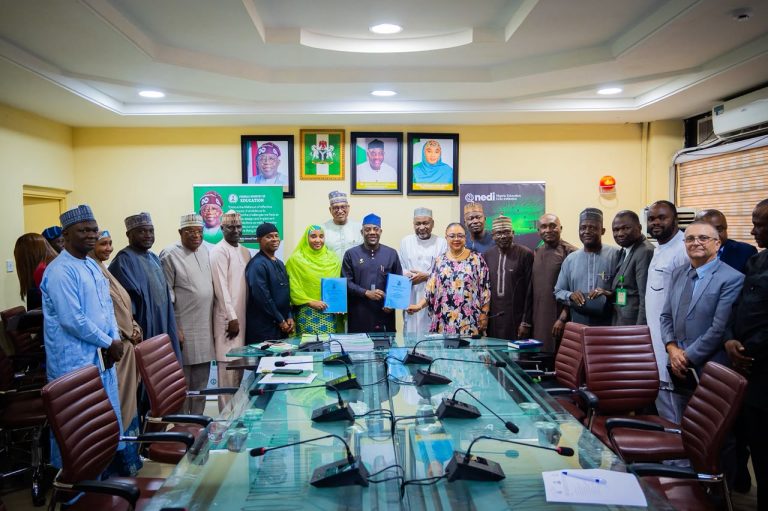
The Minister of Education, Dr Maruf Tunji Alausa, disclosed this while receiving the report of the National Implementation Committee on the Review and Development of Agricultural Curricula for Tertiary Institutions in Nigeria in Abuja.
Alausa commended the committee for its dedication and extensive work, describing the shift to 80 percent practical training as a major step towards equipping Nigerian youths with relevant skills and advancing the economic objectives of the Renewed Hope Agenda of President Bola Ahmed Tinubu.
He said the revised approach represents a significant departure from the previous 70 percent theoretical and 30 per cent practical model.
Read Also: Stakeholders Push for Rapid Adoption of Skills Recognition Framework in Nigeria
The Minister explained that the new structure, comprising 80 percent practical training and 20 percent theory, is designed to provide learners with the hands-on experience required to participate effectively in the agricultural sector.
“The new approach will produce a better-trained workforce, strengthen capacity in agriculture and translate training into productive activity that contributes to national development. The ultimate objective is to ensure that young Nigerians acquire practical skills that can be applied beyond the classroom,” he said.
Alausa also called for a comprehensive rollout of the new curricula, stressing the need for effective sensitisation of industry players, academics, teachers and other stakeholders on the rationale behind the reforms.
He emphasised the importance of adequate teacher training and the necessary support for institutions to implement the new curricula effectively.
Earlier, the Minister of State for Education, Professor Suwaiba Sa’id Ahmad, commended the committee for its commitment and acknowledged the contributions of the National Board for Technical Education (NBTE), the Skills Council, industry representatives and academics to the review process.
She said the collaboration had strengthened the process and enriched the development of the new curricula.
Professor Ahmad expressed optimism that the reviewed curricula would deliver visible results in the agricultural sector.
“There is the need to engage stakeholders and the public on the reforms, particularly the increased emphasis on practical training, to promote understanding and support for effective implementation,” she said.
Presenting the report on behalf of the committee, the Executive Secretary of NBTE, Professor Idris Muhammad Bugaje, disclosed that the exercise produced 36 new and reviewed National Diploma (ND) and Higher National Diploma (HND) curricula, three Nigeria Certificate in Education (NCE) curricula and 31 National Occupational Standards.
“Twenty-seven of the standards were developed from scratch, while four existing standards were reviewed, significantly expanding the framework for skills training in agriculture,” he said.
Professor Bugaje said the assignment had been completed, with the resulting documents considered and approved by the relevant regulatory bodies, including the Board and Commission.
He also explained that the complete set of curricula would be formally presented at a later public event, describing the outcome as a major boost to agricultural skills development.
Alausa gave the assurance that the Ministry would work with NBTE, institutions, industry and other stakeholders to ensure effective implementation of the reviewed curricula.
He said the focus would remain on equipping young Nigerians with practical skills, strengthening the agricultural sector and transforming Nigeria’s agricultural potential into productive opportunities in line with President Bola Ahmed Tinubu’s Renewed Hope Agenda.