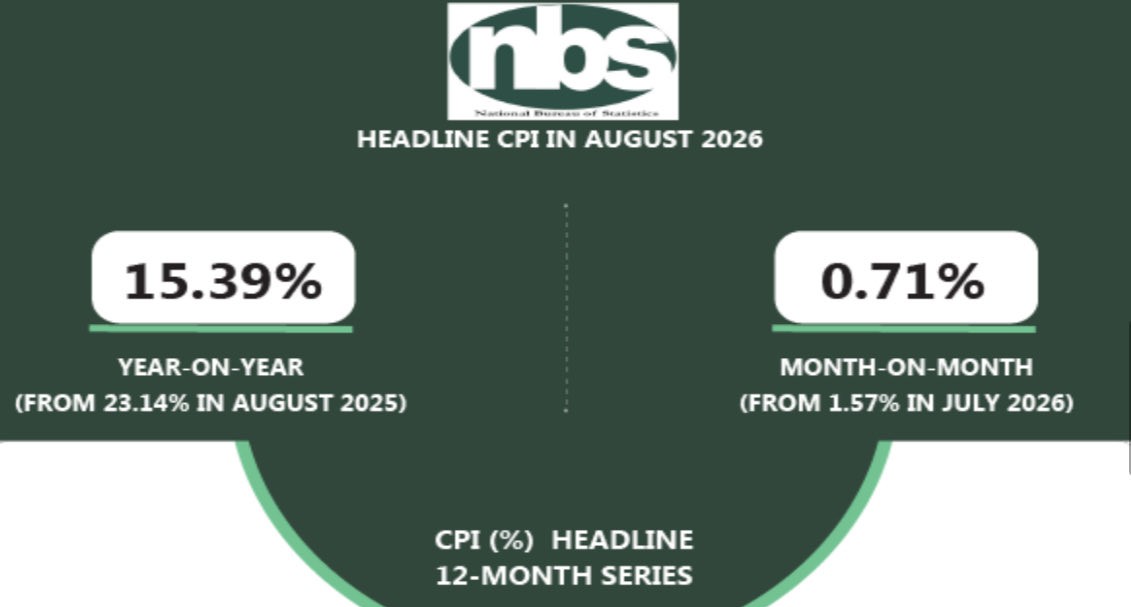
Nigeria’s headline inflation rate fell marginally to 15.39 per cent in August 2026, from 15.43 per cent recorded in July, according to the latest Consumer Price Index (CPI) report released by the National Bureau of Statistics (NBS).
The latest figures were contained in a statement issued by the Statistician-General of the Federation and Chief Executive Officer of the NBS, Prince Adeyemi Adeniran.
The NBS said the August CPI stood at 146.3, representing a 1.0-point increase from the preceding month.
READ ALSO: Nigeria’s Headline Inflation Drops to 15.43% in July
In August 2026, the Headline inflation rate stood at 15.39%.
On a month-on-month basis, the Headline inflation rate was 0.71%.
The Food inflation rate was 19.57% year-on-year and 1.02% Month-on-Month.
Read the August 2026 CPI Report here: https://t.co/so6qTYLs0a pic.twitter.com/K7o32I0FU3
— NBS Nigeria (@NBS_Nigeria) September 15, 2026
The latest CPI followed the recent rebasing exercise, which adopted 2024 as the new CPI base year and 2023 as the weight reference period.
According to the NBS, the year-on-year headline inflation rate of 15.39 per cent in August was lower than the 23.14 per cent recorded in August 2025.
The month-on-month headline inflation rate also declined to 0.71 per cent in August, compared with 1.57 per cent in July.
The NBS explained that the development indicated that the average prices of goods and services increased at a slower rate during the month under review.
Food Prices
Despite the moderation in headline inflation, food prices continued to exert pressure on consumers.
The NBS reported that food inflation stood at 19.57 per cent year-on-year in August 2026, compared with 25.30 per cent recorded in August 2025.
On a month-on-month basis, food inflation declined to 1.02 per cent, from 5.56 per cent in July.
The NBS attributed the decline mainly to changes in the average prices of several food items, including palm oil, carrots, pepper, onions, cassava flour, beef, yam flour, water yam, melon (egusi), fresh ginger, fresh fish, Irish potatoes, wheat grain, frozen chicken and turkey meat.
Food and non-alcoholic beverages remained the largest contributor to headline inflation, accounting for 6.16 per cent at the divisional level.
Other major contributors were restaurants and accommodation services, with 1.99 per cent, and transport, with 1.64 per cent.
Core Inflation Declines
Core inflation, which excludes the prices of volatile agricultural produce and energy, stood at 13.29 per cent year-on-year in August.
On a month-on-month basis, core inflation was -0.06 per cent, representing a decline from the 0.15 per cent recorded in July.
The NBS also reported that the monthly inflation rates for the newly introduced sub-indices were 1.35 per cent for farm produce, -0.36 per cent for energy, 0.12 per cent for services, 0.45 per cent for goods and 0.91 per cent for imported food.
Urban-Rural Disparity
The report revealed differences in inflationary trends between urban and rural areas.
Urban inflation stood at 15.88 per cent year-on-year in August, while the month-on-month rate declined to 0.28 per cent from 1.90 per cent in July.
In contrast, rural inflation stood at 14.23 per cent year-on-year, while the month-on-month rate increased to 1.79 per cent, compared with 0.78 per cent in July.
At the state level, Lagos recorded the highest year-on-year headline inflation rate at 23.68 per cent, followed by Zamfara at 22.56 per cent and Enugu at 22.06 per cent.
Sokoto recorded the lowest year-on-year headline inflation rate at 2.11 per cent, followed by Kebbi at 3.72 per cent and Jigawa at 3.81 per cent.
On a month-on-month basis, Rivers recorded the highest increase at 6.92 per cent, followed by Osun at 5.61 per cent and Kano at 5.59 per cent.
Anambra recorded the lowest month-on-month movement at -8.83 per cent, followed by Bauchi at -7.13 per cent and Borno at -7.09 per cent.
State Food Inflation
Adamawa recorded the highest year-on-year food inflation rate at 38.85 per cent, followed by Zamfara at 37.96 per cent and Bayelsa at 36.20 per cent.
Borno recorded the lowest rate at -4.04 per cent, followed by Jigawa at -0.23 per cent and Kebbi at 3.47 per cent.
On a month-on-month basis, Katsina recorded the highest food inflation rate at 9.48 per cent, followed by Rivers at 8.86 per cent and Osun at 8.32 per cent.
Taraba recorded the lowest month-on-month food inflation rate at -12.42 per cent, followed by Borno at -12.15 per cent and Bauchi at -8.88 per cent.