
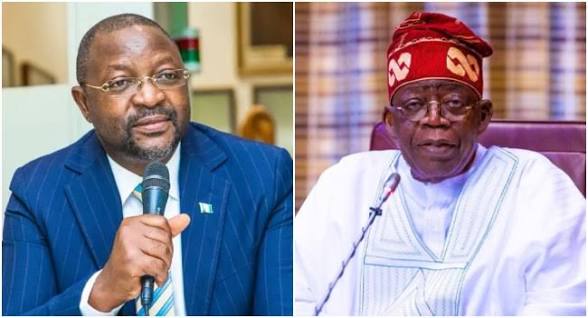
The Special Adviser to the President on Media and Public Communications, Dr Sunday Dare, says President Bola Ahmed Tinubu’s administration has dismantled decades of economic distortions through far-reaching reforms that have reshaped Nigeria’s economic trajectory.
Dare said the removal of fuel subsidy on the administration’s first day in office ended a major drain on public resources, saving the federation trillions of naira for capital development and fiscal sustainability.
The Special Adviser stated this in an article titled, “Beyond The Economist Condescension: Nigeria’s Re-Engineering Under Tinubu Is Unstoppable,” in which he rejected claims by The Economist and other foreign commentators portraying Nigerians as overwhelmingly dissatisfied with President Tinubu and the country as being trapped in economic decline.
According to Dare, such assessments failed to capture the complexities of Nigeria’s political and economic environment and the scale of structural reforms undertaken by the administration since May 2023.
“It has become a tired, predictable ritual of external commentary to look at the complex, dynamic and pulsating canvas of the Federal Republic of Nigeria through a cracked, distorted lens,” he said.
The Special Adviser criticised what he described as sensationalist half-truths, arguing that localised difficulties associated with the reforms were being turned into a uniform narrative of national rejection.
He maintained that any fair assessment of President Tinubu’s stewardship must begin with the state of the economy inherited by the administration in May 2023, which he described as being weighed down by longstanding structural weaknesses and severe fiscal pressures.
According to him, the administration inherited an economy burdened by an unsustainable fuel subsidy regime, multiple foreign exchange windows, a debt service-to-revenue ratio of about 95 per cent and decades of inadequate investment in infrastructure, security and the energy sector.
“For decades, the opaque, resource-draining and rent-seeking fuel subsidy regime operated as a monumental financial leak, siphoning trillions away from public infrastructure, education and healthcare,” Dare emphasised.
He said it would be unrealistic to expect structural problems accumulated over several decades to disappear without transitional difficulties, adding that President Tinubu chose to confront the underlying distortions rather than postpone difficult decisions.
Dare also pointed to the rationalisation of the foreign exchange market, saying it had reduced systemic arbitrage, strengthened foreign portfolio investment and contributed to improvements in trade surpluses and external reserves, which he described as indicators of renewed investor confidence.
He highlighted the establishment of the Nigerian Education Loan Fund, NELFUND, saying hundreds of thousands of students who might otherwise have been unable to finance their tertiary education were now receiving support under the programme.
According to Dare, other interventions included financial autonomy for local governments, an upward review of the national minimum wage, targeted palliatives and the deployment of Compressed Natural Gas (CNG) buses to cushion Nigerians against inflationary pressures and reduce transport costs.
On agriculture, the Special Adviser said the administration had launched large-scale fertiliser distribution, agricultural loans, and the deployment of modern farming equipment, including thousands of tractors, to strengthen food production and promote food security.
Dare argued that these interventions challenged suggestions that Nigerians universally rejected the President and his policies, pointing to students and parents benefiting from NELFUND, public servants affected by wage increases, local government authorities with greater control over resources and farmers receiving targeted support.
He maintained that such beneficiaries understood that the administration was undertaking the difficult foundational work required to address years of accumulated economic and governance challenges.
While acknowledging the challenges posed by insecurity and global economic headwinds, Dare faulted attempts by external commentators to portray Nigeria as trapped in helplessness and misery.
He maintained that President Tinubu’s reforms were placing Nigeria on a sustainable path towards stronger growth, fiscal independence and long-term prosperity.
“President Bola Ahmed Tinubu remains a master strategist whose bold, unyielding policy posture has put the nation on an irreversible path towards sustainable growth, fiscal independence and enduring prosperity,” Dare stressed.

