Some eminent scholars have called for stronger institutions, inclusive representation and ethical leadership, arguing that Nigeria’s development ambitions can be achieved through leadership that translates public policies, national resources and democratic governance into tangible improvements in citizens’ lives.
They made the call during paper presentations at the 5th Annual Conference of the Forum of Former Deputy Governors of Nigeria, held in Abuja, with the theme, “Rethinking Nation-Building: Bridging the Leadership-Citizenship Disconnect Through Orientation, Attitude, Character, Culture and Tradition for Sustainable Development.”
Presenting a paper titled “Leadership Disconnect and Development Outcomes in Nigeria: A Critical Analysis of the Political, Social and Economic Landscape from 1999 to 2026”, Professor Taslim Ayobami Hammed of the University of Ibadan argued that democratic continuity had not automatically translated into inclusive development.
READ ALSO: FUL New Vice-Chancellor Vows to Add Value to University
Hammed identified persistent poverty, insecurity, educational exclusion, weak infrastructure, unemployment and inadequate social protection as evidence of the widening gap between governance and citizens’ welfare.
He maintained that leadership failure was evident when economic growth failed to generate adequate employment, public spending did not deliver corresponding services, and national policies failed to improve living conditions.
“Leadership disconnect constitutes an important part of Nigeria’s development challenge,” he said.
Hammed advocated a shift from elite-centred governance to citizen-centred development, with stronger institutions, policies that survive electoral cycles and development strategies measured by outcomes rather than announcements.
“The ultimate test of Nigerian leadership should therefore be simple: Does leadership improve the quality of life of the Nigerian people?” he asked.
In a paper on “Culture, Tradition and Modern Governance”, Professor Victor Dugga of the Federal University of Lafia recommended integrated biometric identification, investment in surveillance and forensic technology, and community-based security partnerships that draw on indigenous knowledge and traditional institutions.
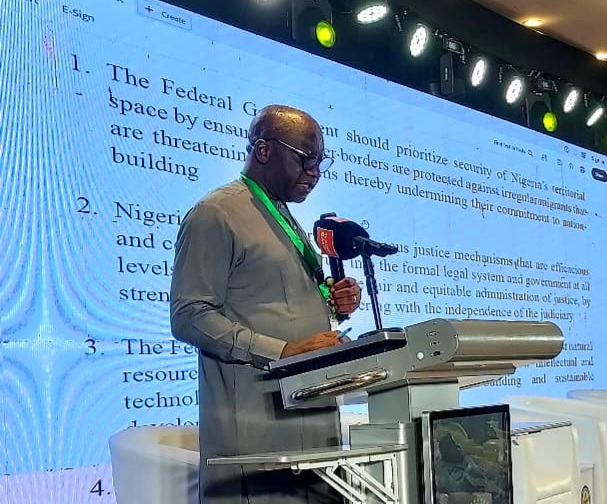
Dugga also advocated constitutional and electoral reforms to reserve legislative seats for women at federal, state and local levels, alongside representation for young people, workers, persons with disabilities and other marginalised groups.
He urged Nigeria to document and teach indigenous governance history while avoiding the uncritical adoption of exclusionary practices from the past.
“There is no single formula for governance in diverse societies,” the paper stated, advocating a pragmatic balance between centralisation and autonomy.
Professor Iniobong Uko, Deputy Vice-Chancellor (Academic) of the University of Uyo, described character, integrity and ethical governance as indispensable to Nigeria’s democratic consolidation and socioeconomic transformation.
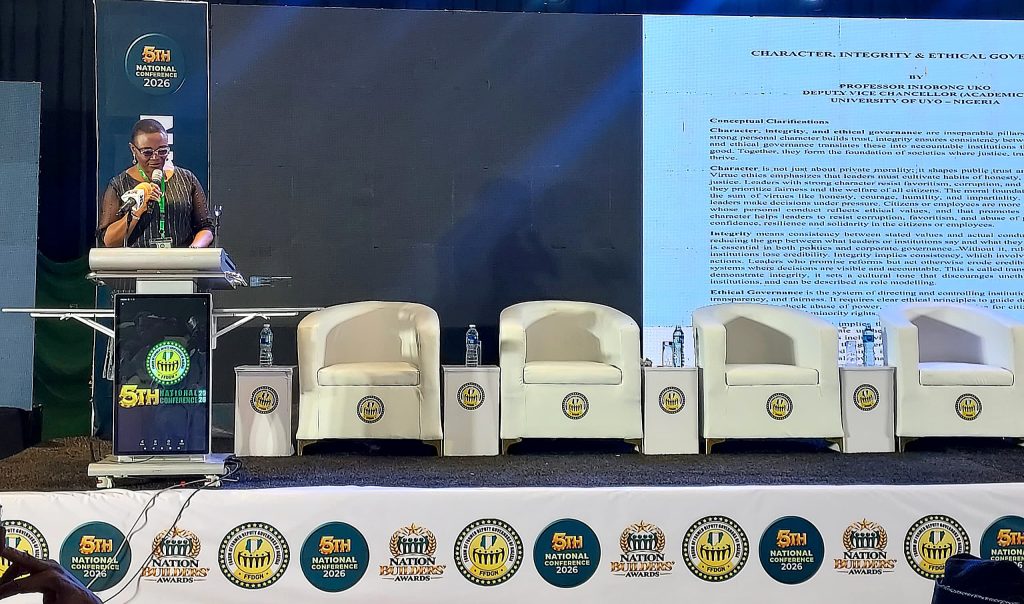
“Ethical governance is not just about institutions; it is about people,” Uko said, advocating ethical education, stronger institutions, sustained political will and active youth participation.
Uko stressed that integrity must translate values into action, while transparent and inclusive systems protect justice, equity and accountability. She also identified corruption, political interference and gaps in inclusion as continuing obstacles.
The papers underscored the conference’s central message that sustainable nation-building requires leadership grounded in character and accountability, institutions responsive to citizens, inclusive governance and measurable improvements in human wellbeing.