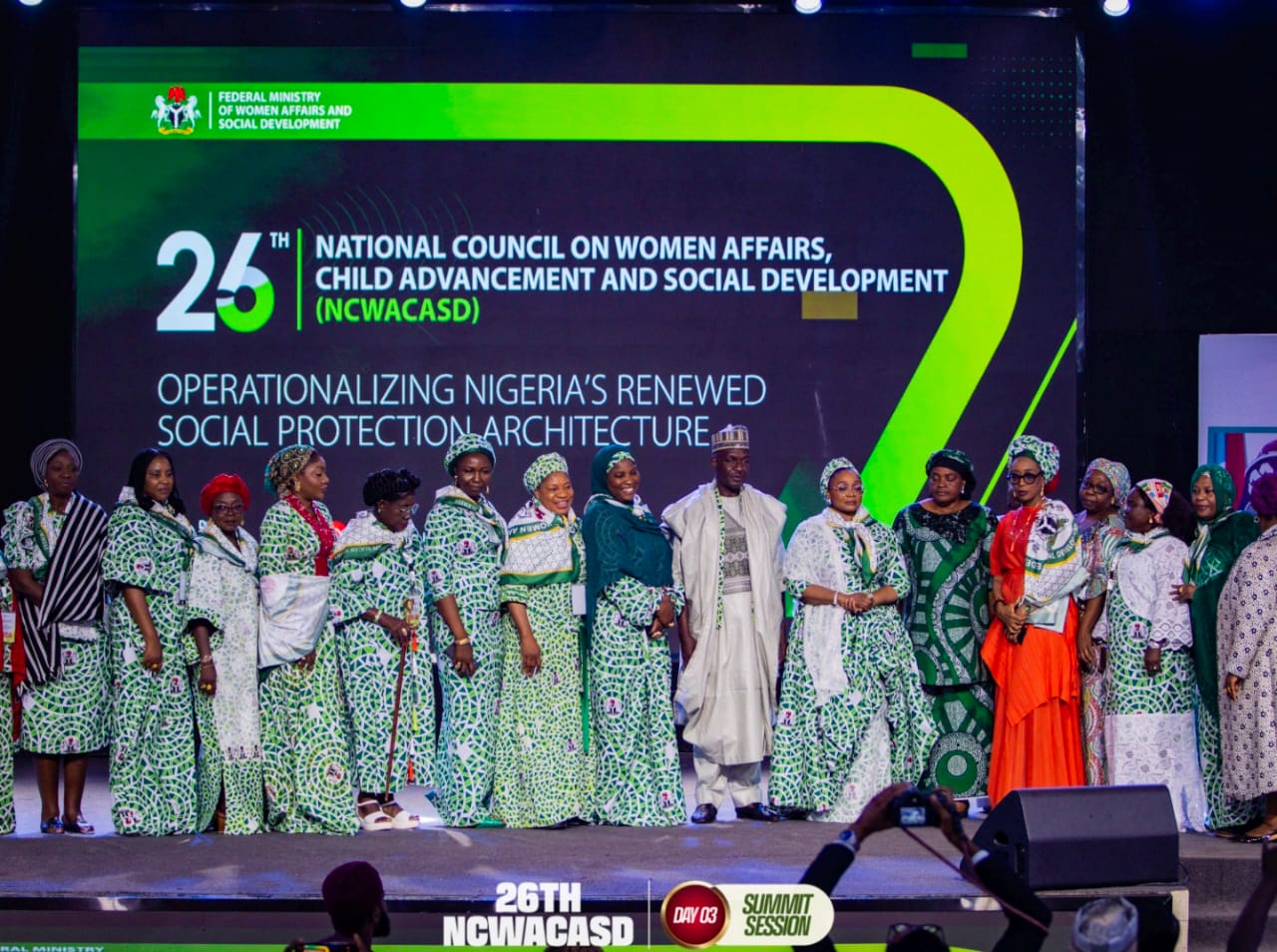
The Minister of Women Affairs and Social Development, Hajiya Imaan Sulaiman-Ibrahim, has urged the 36 states and the Federal Capital Territory to translate social protection policies into measurable action that strengthens families, expands the care economy and protects vulnerable Nigerians.
Delivering the Ministerial Address at the 26th National Council on Women Affairs, Child Advancement and Social Development in Jalingo, Taraba State, Sulaiman-Ibrahim said the Council must become an accountability platform rather than an annual ceremony.
“What we resolve here must be found next year in State budgets, in State work plans and in the lives of the people we serve.” She stated
The Minister said President Bola Ahmed Tinubu’s declaration of 2026 as the Year of Families and Social Development created a strategic opportunity to strengthen family welfare and inclusive development.
She described care as critical economic infrastructure, noting that unpaid care work disproportionately performed by women limits their participation in the formal economy.
“Care is not a private matter to be absorbed silently within the household. It is infrastructure, and it should be treated, financed and regulated as such.”
She urged states to invest in childcare, early childhood development, elderly and disability care, community health and social-care infrastructure.
Sulaiman-Ibrahim disclosed that the Ministry had developed, reviewed and validated 38 new policy instruments, bringing its portfolio to 42, covering childcare, gender equality, women’s economic empowerment, social protection, disability inclusion and family support.
She challenged states to domesticate them. “These instruments were built to be domesticated, not admired.”
On social protection, the minister identified fragmented registers, weak targeting, inadequate coverage and project-based interventions as major challenges.
She proposed four tests for state systems: a single credible register, predictable financing, shock-responsive design and household-level case management.
“A social protection architecture worthy of the name has four features: a single credible register, predictable financing on a budget line rather than a project cycle, shock-responsive design that can expand when flood or conflict or displacement strikes, and a case management system that follows a household rather than a programme.”
She also demanded stronger data systems and quarterly reporting. “We cannot plan what we do not measure. We cannot defend a budget we cannot evidence.”
The Minister highlighted the Nigeria for Women Programme Scale-Up, targeting 4.5 million women through 300,000 Women Affinity Groups, alongside RH-WAVE, WINGS and Women on Wheels.
“Our focus is to enable women to accumulate and retain capital by receiving an income-generating asset that she comes to own.”
She urged states to implement the Child Rights Act and Violence Against Persons (Prohibition) Act, strengthen coordination and engage traditional, religious and male political leaders.
“We will not deliver this agenda by speaking to women alone.”
For the first time, states will be assessed and recognised for performance in policy domestication, budgets, programme delivery, data reporting and innovation.
“This Council is not a circus. It is a delivery platform, and next year we will report against what we resolved this week. From this Council forward, performance at the National Council will be assessed, published and rewarded.”
Representing Governor Agbu Kefas, Taraba Head of Civil Service, Dr Hamidu Kara, pledged continued state support, saying:
“When women are empowered, families become stronger. When children are protected and educated, communities become more resilient. And when vulnerable persons are supported, development becomes more inclusive.”
The Taraba Commissioner for Women Affairs and Child Development, Mrs Mary Sinjen, said the Council provided an opportunity to turn national policies into practical grassroots interventions, calling for stronger coordination and solutions capable of delivering tangible improvements for women, children, families and vulnerable persons.
The four-day Council brings together federal and state officials, development partners, civil society organisations, traditional and religious leaders, academia, the private sector and representatives of vulnerable groups to review progress and establish a measurable policy agenda for women, children, families and social development.