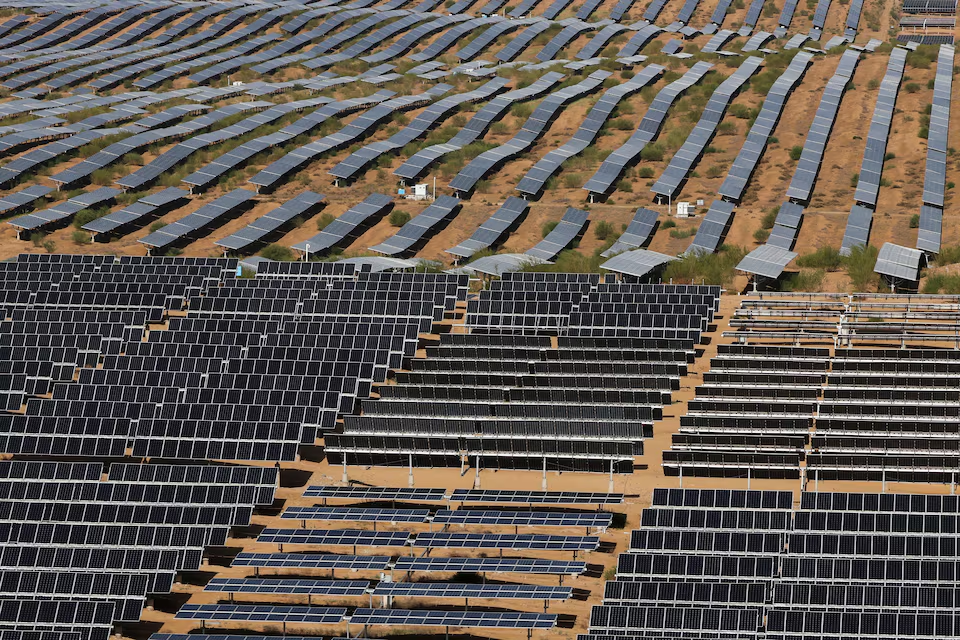
China is rejecting record amounts of renewable energy as electricity grid constraints struggle to keep pace with the country’s rapid expansion of wind and solar power generation.
A report published by Global Energy Monitor (GEM) and the Centre for Research on Energy and Clean Air (CREA) estimates that China curtailed 360 terawatt-hours (TWh) of clean electricity between January and June 2026, a 49 per cent increase compared with the same period last year.
The report noted that the volume of rejected clean energy during the six-month period was enough to power Mexico for an entire year.
READ ALSO: Nigeria Targets More Exports Under China’s Zero-Tariff Policy
Analysts attributed the growing curtailment of renewable energy to inadequate transmission infrastructure and electricity supply arrangements that continue to guarantee operating hours for newly built coal-fired power plants.
According to an analyst at consultancy Wood Mackenzie, Yuan Ren, the challenge is likely to persist in the coming years.
“Curtailment in China is structural, not a temporary bottleneck. We expect curtailment pressure to continue through the rest of this decade,” Ren said.
The report’s estimates were significantly higher than figures released by the Chinese government.
It also noted that rising curtailment, combined with a policy ending guaranteed fixed prices for renewable energy, has contributed to a 66 per cent decline in new solar installations in China this year.
Meanwhile, coal-fired power generation is expected to increase again, reversing a decline recorded for the first time in a decade.
China’s National Energy Administration said 8.6 per cent of solar generation and 9.1 per cent of wind generation were curtailed during the first half of 2026.
However, GEM and CREA estimated that 26.1 per cent of China’s combined wind and solar generation was rejected during the same period, using weather-adjusted data to account for unreported curtailment.
Experts warned that increasing curtailment is creating uncertainty for renewable energy investors and making it more difficult to assess the financial viability of projects.
The Chief Economist at Beijing-based consultancy Draworld Environment Institute, Shawn Shuwei Zhang, said growing curtailment was complicating investment planning across the sector.
The report noted that renewable energy investment is increasingly shifting from standalone solar projects to solar-plus-storage systems, which can help reduce exposure to curtailment.
Beyond China, electricity grids in several countries are also facing similar challenges as renewable energy capacity expands.
Data from Australia’s National Electricity Market showed that curtailment rose 37 per cent to 2.93 TWh during the first half of 2026, accounting for seven per cent of wind and solar generation.
In Japan, electricity grids rejected 2.35 TWh of renewable energy during the same period, representing four per cent of renewable generation and a 34 per cent increase from a year earlier.
India, the world’s third-largest solar power producer, curtailed 8.13 TWh of solar electricity during the quarter ending in June, equivalent to 14 per cent of solar generation during the period.
Analysts said improved deployment of renewable energy infrastructure and expanded battery storage capacity could help reduce curtailment globally.
An analyst at energy think tank Ember, Kostantsa Rangelova, cited Chile as an example of how investment in battery storage can help absorb excess renewable power.
“Chile added 4 GWh of batteries in 2025, more than doubling its installed capacity. Most of this new storage was co-located with solar plants, helping reduce curtailment,” Rangelova said.
Reuters