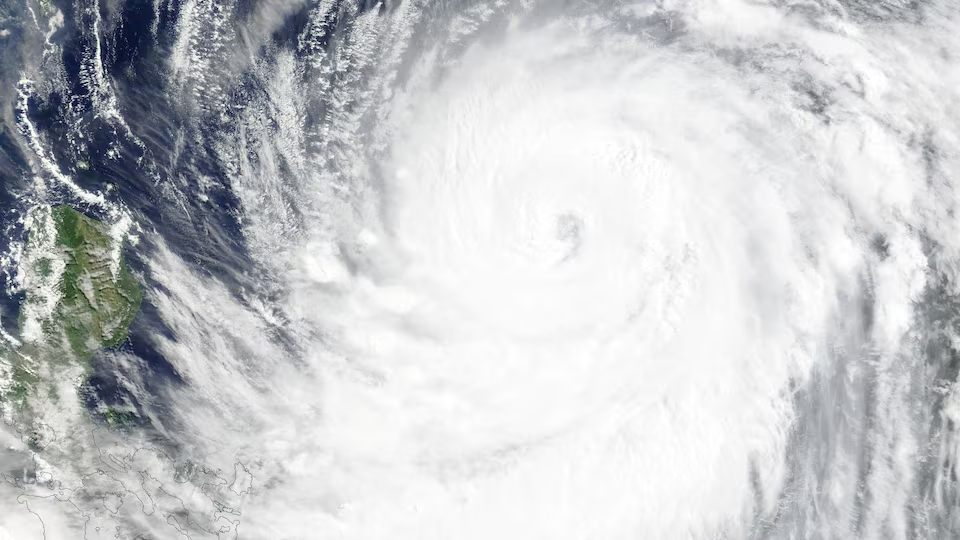
China and Taiwan are bracing for what could be one of the most destructive tropical storms in years as Typhoon Bavi intensifies southeast of Taiwan, bringing winds of nearly 200 km/h and raising fears of widespread flooding, landslides and infrastructure damage.
The looming storm comes as parts of China continue to recover from the devastation caused by Typhoon Maysak, which killed at least 39 people in the Guangxi region earlier this week, with nine people still missing.
Taiwanese authorities have warned that mountainous areas in the north of the island, including regions around Taipei, could receive up to one metre of rainfall. The defence ministry said about 29,000 soldiers had been placed on standby as the island prepared for what may be its strongest typhoon since Typhoon Kong-rey in 2024.
China’s National Meteorological Centre said Bavi, which currently spans about 1,000 km, is expected to pass north of Taiwan before making landfall in China’s eastern Fujian province on Saturday evening.
Jason Chang, a forecaster with Taiwan’s Central Weather Administration, described the storm as unusually large.
“Bavi is expected to be the largest storm to affect Taiwan since 1987,” he told reporters, noting that storms of such magnitude had been relatively rare in recent years.
READ ALSO: Philippines Evacuates 100,000 People as Super Typhoon Surges
Meanwhile, rescue teams in China are still searching through debris left by Typhoon Maysak, which killed at least 39 people after sweeping through the Guangxi region earlier this week. Local officials said nine people remain missing.
Scientists have warned that China, Taiwan and Japan are becoming increasingly vulnerable to extreme weather linked to climate change. Concerns are heightened this year because the anticipated arrival of El Niño could raise temperatures and contribute to stronger and more frequent typhoons.
“Some loss of wind intensity is anticipated starting Thursday, but Bavi will remain a dangerous storm as it impacts Taiwan and eastern China later Friday into Monday,” said Jason Nicholls, an expert at AccuWeather.
Residents Seek Safety
In Taiwan’s northeastern fishing town of Suao, hundreds of fishing boats crowded the harbour for protection as residents collected sandbags and farmers hurried to harvest rice before the weather deteriorates.
Chen Ming-hui, a 60-year-old fishing boat captain, expressed hope that the typhoon would shift further north to avoid a direct strike, recalling the destruction caused by previous storms.
“Don’t be fooled by the nice and calm weather now. A storm like this could be the most terrifying,” Chen said while checking the ropes securing his boat.
In Japan’s Okinawa Prefecture, about 111 km (68 miles) southwest of Suao, the meteorological agency urged residents to remain alert on Friday and Saturday for destructive winds, flooding, landslides and storm surges.
The aftermath of Typhoon Maysak continues to unfold, with its remnants triggering at least two inland tornadoes and severe flooding in China’s Hubei province.
Communities in Guangxi are still struggling to recover before Bavi’s arrival. State media showed dramatic rescue operations, with residents climbing from second-floor windows onto rescuers’ backs to escape floodwaters while drones delivered emergency supplies to isolated communities.
Beijing News also published images showing rows of dead pigs decomposing after floodwaters submerged a farm in Binyang County for two days.
China’s Global Times reported that three lions died in flooding at Guigang Zoo. According to the zoo’s operator, Wang Liyuan, around 100 animals, including two zebras, four porcupines, dozens of parrots and two North American raccoons—remain missing.
Flights Cancelled Ahead of Landfall
Japan Airlines announced the cancellation of 48 domestic and two international flights scheduled for Friday, affecting approximately 7,610 passengers.
All Nippon Airways also cancelled 34 flights serving Okinawa’s Ishigaki and Miyako airports, impacting about 1,800 travellers on Friday. Another 33 domestic flights are expected to be cancelled on Saturday, affecting roughly 5,900 passengers.
Xiangbo Feng, a tropical cyclone research scientist at Imperial College London, warned that Bavi’s long period of strengthening over the Pacific Ocean has made it particularly dangerous.
“We should pay much attention to Bavi as it has spent a long time intensifying over the open Pacific, extracting energy from warm ocean and accumulating large amounts of moisture,” Feng said.
“When it would make landfall or get close to coastal regions, the damage could be catastrophic. A small change in Bavi’s track could have a significant influence,” Feng added.
Reuters