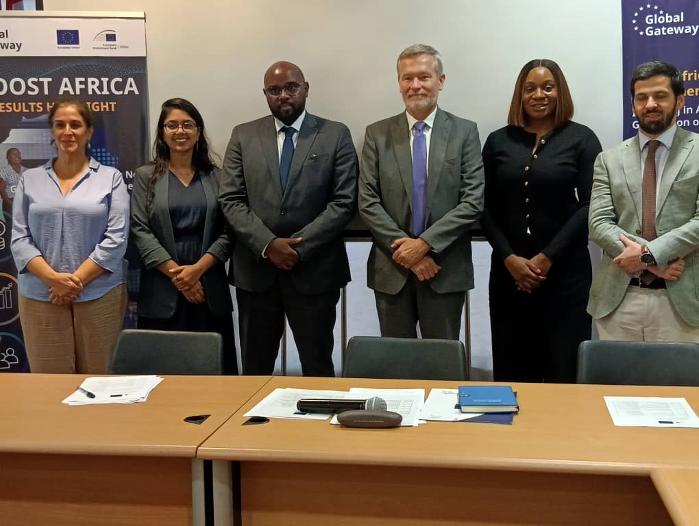
The European Union (EU) and the European Investment Bank (EIB) have highlighted the impact of their Boost Africa initiative in supporting entrepreneurs, strengthening venture capital ecosystems and creating jobs across Africa, with Nigeria emerging as one of the programme’s key beneficiary countries.
Speaking at the Boost Africa Impact Forum and Media Briefing in Abuja, EU Ambassador to Nigeria, Gautier Mignot, said the initiative reflected the EU’s long-term commitment to supporting sustainable economic growth, innovation and private-sector development across Africa.
Mignot said the EU’s partnership with Africa was now being implemented under its Global Gateway strategy, through collaboration with EU member states and development finance institutions.
READ ALSO: EU Seeks Broader Support for African Entrepreneurs
He noted that the approach was designed to leverage private investment while creating jobs and opportunities, particularly for young people, and strengthening local value chains.
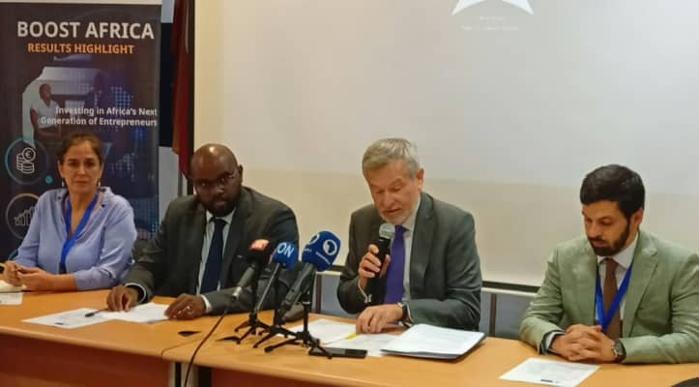
“Today’s event is precisely about more than investment figures: it’s about people, it’s about entrepreneurs, it’s about innovation, it’s about jobs and opportunities created when Africa’s talent is matched with the right partners and the right financing,” Mignot stressed.
According to him, the Boost Africa programme demonstrated how collaboration among the EU, the European Investment Bank (EIB), African Development Bank, venture capital partners and African entrepreneurs could translate investment into measurable economic and social impact.
He said more than €100 million had been invested through the initiative, generating a leverage effect that attracted substantially more private capital and contributed to job creation across sub-Saharan Africa.
Mignot said Nigeria’s vibrant entrepreneurial ecosystem made it particularly important to the partnership.
“Nigeria is one of Africa’s most dynamic entrepreneurial ecosystems, and we believe that supporting innovation and enterprise is essential for sustainable economic growth and job creation,” the Ambassador said.
He added that the EIB had recently launched new operations in Nigeria aimed at continuing to finance entrepreneurs across the country, urging stakeholders to focus not only on the achievements of the past decade but also on expanding opportunities for the next generation of African entrepreneurs.
The EIB Country Relationship Manager for Nigeria, Moussa Koulima, explained that Boost Africa was designed not merely to provide capital to individual businesses, but also to strengthen the wider ecosystem surrounding African entrepreneurs.
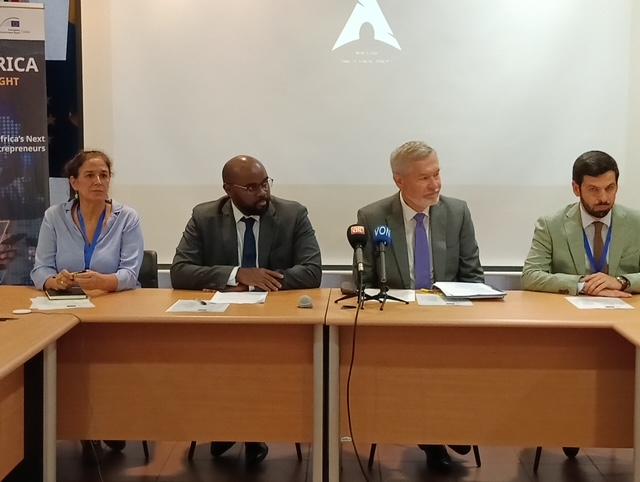
“Africa has a tremendous, extraordinary, energetic, young and talented population, and a growing community of businessmen and businesswomen that are developing solutions in the financial sector, in healthcare, digital economy, renewable energy, you name it,” Koulima highlighted.
He, however, noted that access to capital, particularly at the earliest and riskiest stages of business development, remained one of the biggest constraints facing entrepreneurs.
“Boost Africa was launched in 2016 by the EIB and African Development Bank, with support from the European Union and the Organisation of African, Caribbean and Pacific States (OACPS), to address that financing gap,” the EIB Country Relationship Manager explained.
Koulima further said that the programme operated differently from a traditional commercial bank because it invested through venture capital funds and other financial intermediaries that identified and financed early-stage start-ups and small and medium-sized businesses.
“It’s a smart combination of capital and capacity, identifying three main pillars of the initiative: investment capital, technical assistance and ecosystem development
“The technical assistance component provides support in areas such as accounting, market analysis and legal structuring, while ecosystem development includes incubators, accelerators, networking and knowledge-sharing initiatives,” he stated.
The EIB Country Relationship Manager said that over the programme’s first decade, €108 million had been invested through Boost Africa, helping to attract an additional €400 million from other investors.
“For every single euro that was invested through Boost Africa, we were able to attract an additional three euros through different investors, which is one of the programme’s most important achievements,” Koulima stressed.
According to him, the initiative was particularly relevant to Nigeria because of the country’s large and youthful population, vibrant start-up ecosystem and strong entrepreneurial talent, despite persistent difficulties in accessing early-stage capital.
Koulima stressed that the ultimate ambition was not simply to create more Nigerian start-ups but to help businesses scale across African markets.
“When an entrepreneur in Lagos develops a solution that can be subsequently operating in Ghana, in Côte d’Ivoire, in South Africa, in Kenya, we are beginning to see the real creation, value creation, creation of genuine Pan-African champions,” the EIB official stated.
For her part, the Investment Director of Cathay AfricInvest Innovation Fund (CAIF), Lavanya Anand, said support from the EIB and Boost Africa had been instrumental in strengthening both the fund and its portfolio companies.
“CAIF is a €110 million venture capital fund established in 2019 to invest primarily in Series A technology companies across Africa,” Anand explained.
The Investment Director said the EIB was one of the fund’s anchor investors, while Boost Africa provided up to €1 million in technical assistance for projects involving portfolio companies and the investment team.
She highlighted the experiences of three companies—Turaco, GoMyCode and OZE—as examples of how technical assistance could complement investment capital.
Anand said the support demonstrated that the role of venture capital extended beyond simply injecting money into businesses.
“Capital alone does not build a great company, early-stage businesses often needed help developing leadership, governance, financial management and commercial capabilities,” Anand emphasised.
She added that the fund’s 15 portfolio companies had collectively created 7,600 direct jobs and 272,000 indirect jobs, reached more than 46 million people with financial services, trained more than 13,000 students, and contributed to saving more than 3,000 lives.
According to the Chief Strategy Officer of Beacon Power Services (BPS), Christine Adejorooluwa, BPS was founded to address the lack of visibility that utilities often had over their customers, networks and assets, a challenge that contributed to outages, energy losses and revenue leakages.
She said investment from Seedstars Africa Ventures, a Boost Africa beneficiary, came at a critical point in BPS’s development—when the company was moving from proving that its technology worked to scaling across African markets.
“Following the investment, BPS expanded from working with one utility to having a presence in 12 utilities across seven African countries, including Nigeria,” Adejorooluwa disclosed.
She cited technical assistance received through Boost Africa in areas including board governance, business development, public relations and communications.
“The business development support resulted in the recruitment of the company’s Chief Commercial Officer, while governance assistance helped the company transition from a founder-led enterprise into a more institutionally structured business,” Adejorooluwa explained.
Adejorooluwa added that the company’s impact had increasingly become measurable.
“An independent study commissioned through Boost Africa found that BPS’s intervention at one utility helped prevent an average of approximately 78,000 megawatt-hours of lost load, while at another utility it contributed to a reported $191 million increase in revenue. These numbers are important because they demonstrate something bigger than just the growth of BPS itself, they show what can happen when utilities have better information, better visibility, better tools through which they operate,” she concluded.
The speakers agreed that the experience of Boost Africa demonstrated the importance of combining finance with technical expertise, networks and ecosystem development to enable African businesses to scale.