The European Union (EU), the Federal Government, the Kano State Government and other stakeholders have called for a comprehensive “whole-of-society” approach to tackling insecurity and violent conflict in Northern Nigeria, stressing that sustainable peace cannot be achieved through military action alone.
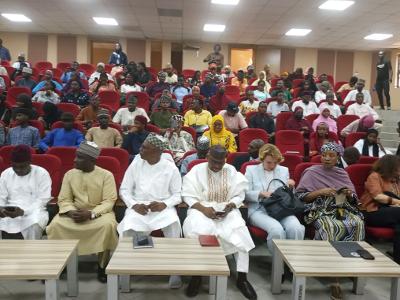
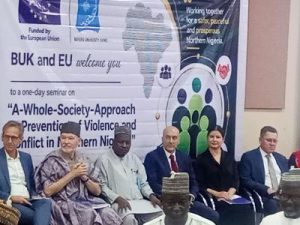
The call was made during a high-level seminar themed “A Whole-of-Society Approach and Conflict in Northern Nigeria” held at Bayero University, Kano (BUK), and attended by 10 European Union ambassadors, government officials, academics, development partners and security experts.
Speaking at the event, the Vice-Chancellor of Bayero University, Professor Haruna Musa, emphasised the institution’s commitment to providing research-driven solutions to societal challenges.
READ ALSO: Nigeria Commits to Fighting Insecurity, Freeing Abductees
He described the seminar as timely, noting that Northern Nigeria continues to grapple with complex security and development issues that require collaboration among government, academia, civil society, traditional institutions and international partners.
“No single institution can solve these challenges alone. It requires government, academia, civil society, traditional institutions, and international partners working together,” Musa said, adding that the university stands ready to support evidence-based interventions through research, data and community engagement.
The European Union Ambassador to Nigeria and ECOWAS, Gautier Mignot, said the delegation selected Kano for its annual diplomatic mission because of its strategic importance as a development hub and its role in shaping the future of Northern Nigeria.
He identified insecurity as one of the most pressing challenges facing the region and stressed the need for inclusive approaches that address the root causes of violence.
Mignot reaffirmed the EU’s commitment to Nigeria, describing the country as a key strategic partner.
EU Support
He disclosed that the EU is implementing development programmes worth hundreds of millions of euros across sectors including education, agriculture, renewable energy, digital infrastructure, health, peace-building and security.
According to him, the EU and its member states have committed about €730 million in grants and €1.5 billion in loans to support Nigeria between 2021 and 2027.
He noted that the EU has increasingly focused attention on Northern Nigeria, particularly the North-West, with new interventions valued at about €300 million aimed at promoting education, youth empowerment, digital development, migration management and community resilience.
Representing the National Security Adviser, Malam Nuhu Ribadu, the Director of State Liaison at the Office of the National Security Adviser, Lami Chinade, said Nigeria’s evolving security challenges require a shift from purely kinetic responses to more preventive and community-based strategies.
She acknowledged the sacrifices of security agencies but stressed that military operations alone cannot sustainably address insecurity if the underlying drivers of violence remain unresolved.
“Our security assessments increasingly point to the reality that while the state has deployed significant kinetic capacity, many of the conditions that facilitate recruitment into violent extremism remain insufficiently addressed,” Chinade said.
Chinade explained that the Federal Government is strengthening non-kinetic approaches focused on prevention, dialogue, social cohesion, education, youth empowerment and community resilience.
She revealed that the Office of the National Security Adviser is spearheading the development of a National Peace Framework designed to institutionalise community-centred peace-building efforts and improve coordination among stakeholders.
According to her, every child kept in school, every young person productively engaged, every community dispute peacefully resolved and every extremist narrative successfully challenged represents a gain for national security.
Also speaking on behalf of Kano State Governor Abba Kabir Yusuf, the Commissioner for Planning and Budget, Musa Shanono, said violence and conflict have imposed enormous costs on Northern Nigeria and underscored the need for collective action.
He noted that peace-building requires the active participation of traditional rulers, religious leaders, women, youths, academia, civil society organisations, government institutions and development partners.
“Peace requires all stakeholders working together, not in silos, but in synergy,” Shanono said.
He commended the European Union for supporting peace and development initiatives in the region and praised Bayero University for providing a platform for meaningful dialogue.
Participants at the seminar agreed that addressing insecurity in Northern Nigeria requires sustained investment in education, economic opportunities, social inclusion, community engagement and strong partnerships among local and international stakeholders.
The event formed part of a broader EU diplomatic visit to Kano State aimed at strengthening cooperation and reviewing ongoing development and peace-building programmes across the region.