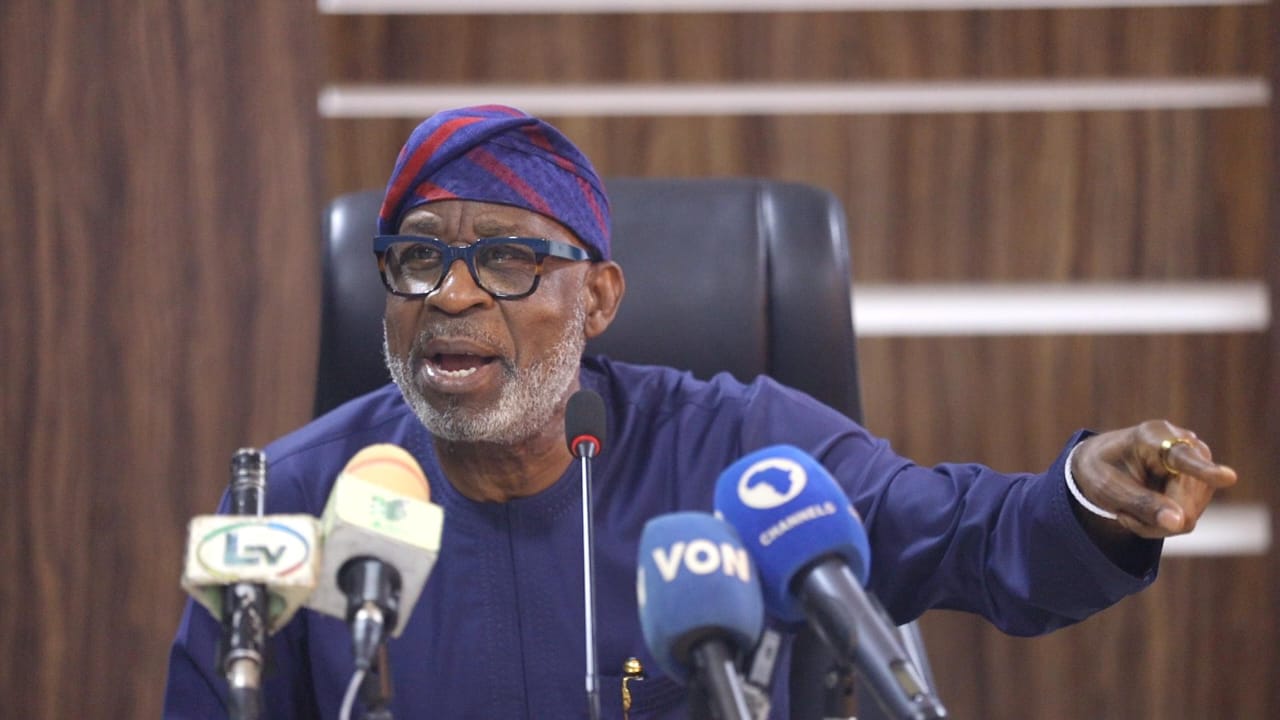
The Minister of Solid Minerals Development, Dr Dele Alake, says the removal of fuel subsidy was necessary to prevent Nigeria’s economy from sinking deeper into crisis.
Alake said the subsidy regime largely benefited fuel cartels and wealthy Nigerians, rather than the majority of citizens.
The Minister stated this while speaking with journalists on the federal government’s economic policies, explaining that the administration of President Bola Tinubu had to take difficult decisions to address longstanding economic challenges.
According to him, previous administrations had identified the need for major economic reforms but were reluctant to implement them because of concerns about their political consequences.
He said President Tinubu had demonstrated the political will to implement reforms considered necessary to reposition the economy.
“When you are in a hole, what do you do? You stop digging. Because the more you dig, the deeper you sink,” Alake said.
The Minister argued that retaining the subsidy would have further worsened the country’s economic situation, alleging that fuel cartels exploited the system by purchasing petrol at subsidised prices and selling it across Nigeria’s borders.
He said the subsidy was also inequitable because households with several vehicles benefited more from subsidised petrol than Nigerians who owned few or no vehicles.
Alake said beneficiaries of the subsidy regime had resisted its removal and attempted to mobilise public opposition against the reform.
While acknowledging the hardship associated with the reforms, he said the sacrifices were necessary to address economic distortions that had accumulated over several years.
Using childbirth as an analogy, the Minister said economic reforms could involve significant pain before their benefits became evident.
READ ALSO:Nigerian Government Invests Fuel Subsidy Savings in Development
He dismissed concerns that Nigerians had waited too long to see the impact of the reforms, saying major economic policies required time to produce measurable results.
According to him, governments must formulate policies, mobilise resources, implement programmes, monitor their execution and make adjustments before the benefits can be fully realised.
Alake said the government had achieved macroeconomic stability, adding that the impact of the reforms was gradually being felt at the microeconomic level.
The Minister also cited President Tinubu’s tenure as governor of Lagos State as evidence of his approach to economic reform.
He recalled that Lagos State generated about N600 million monthly in internally generated revenue in 1999, while its wage bill exceeded N1 billion.
According to him, the administration subsequently blocked revenue leakages, computerised the payroll system and introduced biometric verification.
He said the biometric payroll system saved about N350 million in its first month and exposed ghost workers and non-existent schools on the government payroll.
Alake said the same reform approach was being applied to Nigeria’s economy on a larger scale.
“What Nigeria needs is consistency. We don’t need a reset now. The reforms have come. They are in place, and they are moving ahead,” he said.
The Minister urged journalists to scrutinise government policies and provide adequate context when reporting economic issues.
He also advised the media to distinguish between constructive criticism and narratives that, in his view, could support attempts to reverse the fuel subsidy reform.
Alake further urged journalists to examine the track records of political office seekers and assess their achievements in previous public positions.