

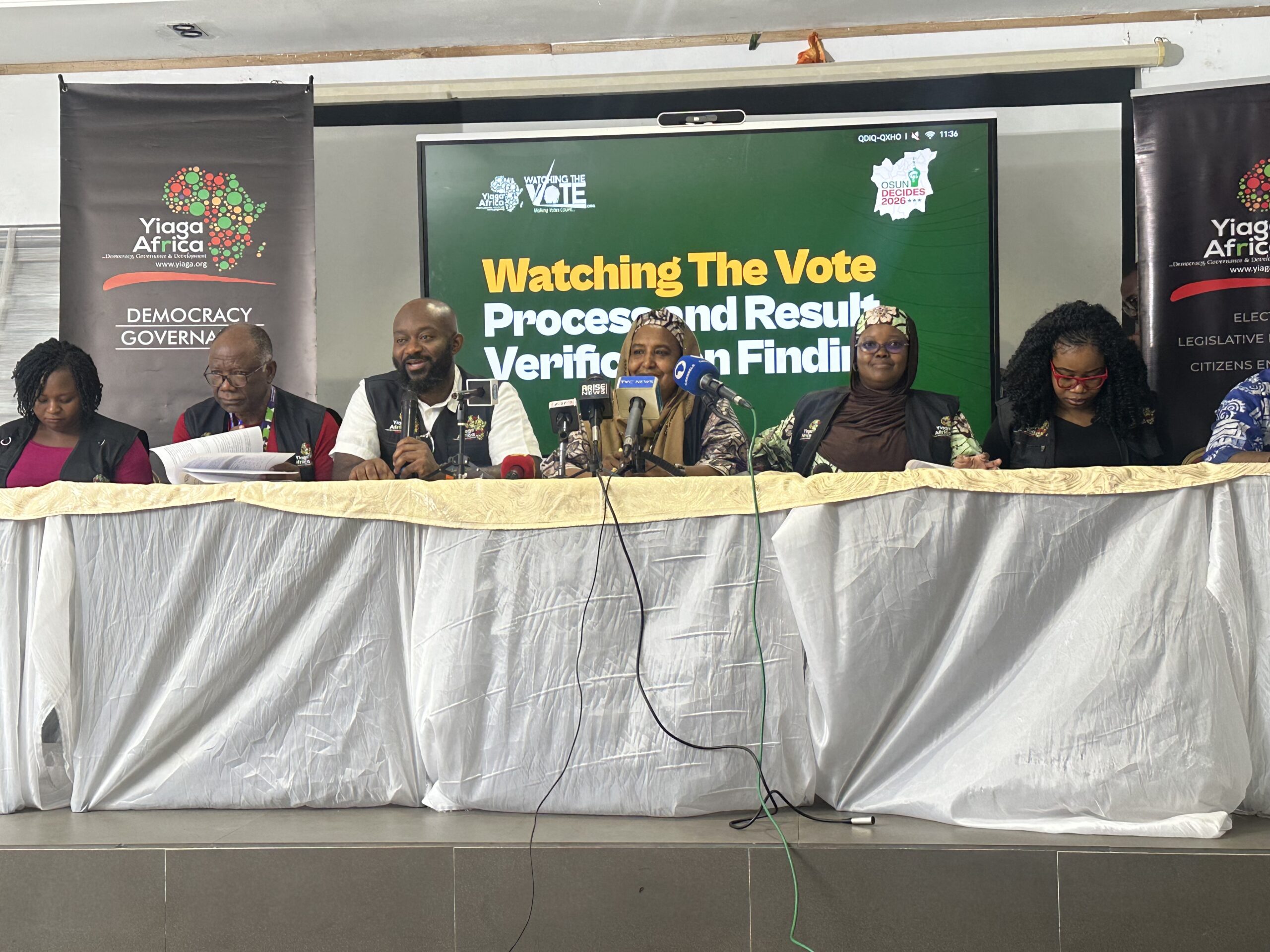
The Independent National Electoral Commission (INEC) has passed an integrity test in the 2026 Osun State governorship election, with Yiaga Africa saying its independent verification showed that the official results reflected the ballots counted at polling units.
It commended the Independent National Electoral Commission (INEC) and security agencies for the largely orderly conduct of the 2026 Osun State governorship election, saying the exercise showed improvements in electoral logistics, technology and results management.
Yiaga Africa, a civil society organisation that promotes credible elections, democratic governance and citizen participation in Nigeria, made the assessment at a press briefing in Osogbo, where it presented its Process and Results Verification for Transparency (PRVT) report on the election.
The organisation said; “its assessment was based on reports from 289 of 300 sampled polling units, representing 96 per cent coverage, with 300 observers, 32 mobile observers and 30 Local Government Area results collation observers deployed across the state.”
According to Yiaga Africa, its statistical analysis showed that the official results announced by INEC fell within the ranges generated from its independent observation.
It described the election as an important test of Nigeria’s electoral preparedness, security neutrality and public confidence, particularly as the first major governorship election to test aspects of the Electoral Act 2026 and the new regulatory framework for election administration and results management.
According to Yiaga Africa, “INEC largely overcame logistical challenges arising from the last-minute court-ordered inclusion of the Social Democratic Party, which required the commission to reprint ballot papers and result sheets shortly before the election.”
It reported that accreditation and voting had commenced in 48 per cent of the polling units observed by 8:30 a.m., rising to 96 per cent by 9:30 a.m.
The organisation said “the performance compared favourably with its observation during the 2022 Osun governorship election, when accreditation and voting had commenced in 41 per cent of polling units by 8:30 a.m. and 96 per cent by 9:30 a.m.”
On the deployment of the Bimodal Voter Accreditation System (BVAS), Yiaga Africa said “the technology functioned properly in 80 per cent of the polling units observed, while malfunctions were recorded in 20 per cent of the sampled units.”
It said most of the affected devices were subsequently fixed, adding that the technological failures recorded did not occur on a scale capable of undermining the election.
The organisation, however, identified cases where elderly voters experienced difficulties with biometric and facial recognition.
Yiaga Africa also observed the use of downloadable Permanent Voter Cards (PVCs), a new provision under the Electoral Act 2026.
It reported that voters presented downloadable copies of their PVCs for accreditation in 23 per cent of the polling units observed, although some voters were denied accreditation in seven per cent of those units.
It further reported that in 11 per cent of polling units, some voters whose PVCs had been successfully verified were denied accreditation because BVAS could not authenticate their fingerprints or facial biometrics.
On the counting process, Yiaga Africa said polling officials showed those present how ballot papers were marked in 99 per cent of the polling units observed, while official results were publicly displayed in 91 per cent.
It said presiding officers used BVAS to scan and transmit Form EC8A results to the INEC Result Viewing Portal (IReV) in 85 per cent of polling units, while results from validated Form EC8A were transferred to the electronic EC8A on BVAS in 87 per cent.
On the final results, Yiaga Africa said its statistical analysis showed that the official figures announced by INEC fell within its estimated ranges.
It estimated that the Accord Party would secure between 50.3 and 54 per cent of the votes, while the African Democratic Congress (ADC) was projected to receive between 1.4 and 2.1 per cent.
For the All Progressives Congress (APC), Yiaga Africa’s estimate placed its vote share between 43 and 46.8 per cent.
INEC’s official results gave Accord 51.9 per cent, ADC 1.7 per cent and APC 45.2 per cent.
Yiaga Africa said the consistency between its independent estimates and INEC’s official results indicated that the figures announced by the electoral commission reflected the ballots counted at polling units.
It, however, stressed that the finding addressed the accuracy of results tabulation and did not remove concerns over voter inducement and vote buying.
The organisation estimated voter turnout at between 42.5 and 44.8 per cent, compared with INEC’s official figure of 43 per cent.
Yiaga Africa also described IReV as an important tool for strengthening transparency in Nigeria’s election results management, saying electronic transmission and publication of polling-unit results provided an additional safeguard against manipulation and enabled independent scrutiny.
It, however, raised concerns over a prolonged interruption in the uploading of results, saying “uploads stalled at 3,292 polling-unit results between 8:48 p.m. and 10:00 p.m., leaving 471 outstanding results before transmission resumed at about 11:50 p.m.”
The stressed that public confidence in IReV requires timely and complete uploads as well as proactive communication whenever technical disruptions occur.
Yiaga Africa also commended the generally professional conduct of security personnel during the election, particularly against the backdrop of pre-election violence, inflammatory rhetoric and concerns over the neutrality of security agencies.
It urged security agencies to sustain the standard and strengthen enforcement against vote buying, intimidation and electoral violence.
The organisation documented several critical incidents, including alleged voter display of marked ballots to party representatives at a polling unit in Boripe Local Government Area.
In Osogbo Local Government Area, Ward 10, Polling Unit 1, the voter register was initially mixed up with materials belonging to another polling unit. The issue was subsequently resolved, but accreditation and voting were delayed until after 11 a.m.
Yiaga Africa said the resilience of Osun voters was a significant feature of the election, noting that citizens turned out despite concerns over attacks on PVC collection centres.
It said the 43 per cent voter turnout should not be interpreted solely as voter apathy, but also as evidence of citizens willing to participate despite concerns about the electoral environment.
The organisation commended voters who remained at polling units to witness the sorting, counting and announcement of results, as well as those who followed the process to ward and Local Government Area collation centres.
It said citizen vigilance remained an important deterrent to electoral manipulation, while stressing that citizens should not have to personally guard electoral institutions to ensure the integrity of elections.

 and security agencies for the largely orderly conduct..)