Nigeria’s Minister of Information and National Orientation, Mohammed Idris, says the economic reforms introduced by President Bola Tinubu are laying the foundation for long-term national prosperity and development.
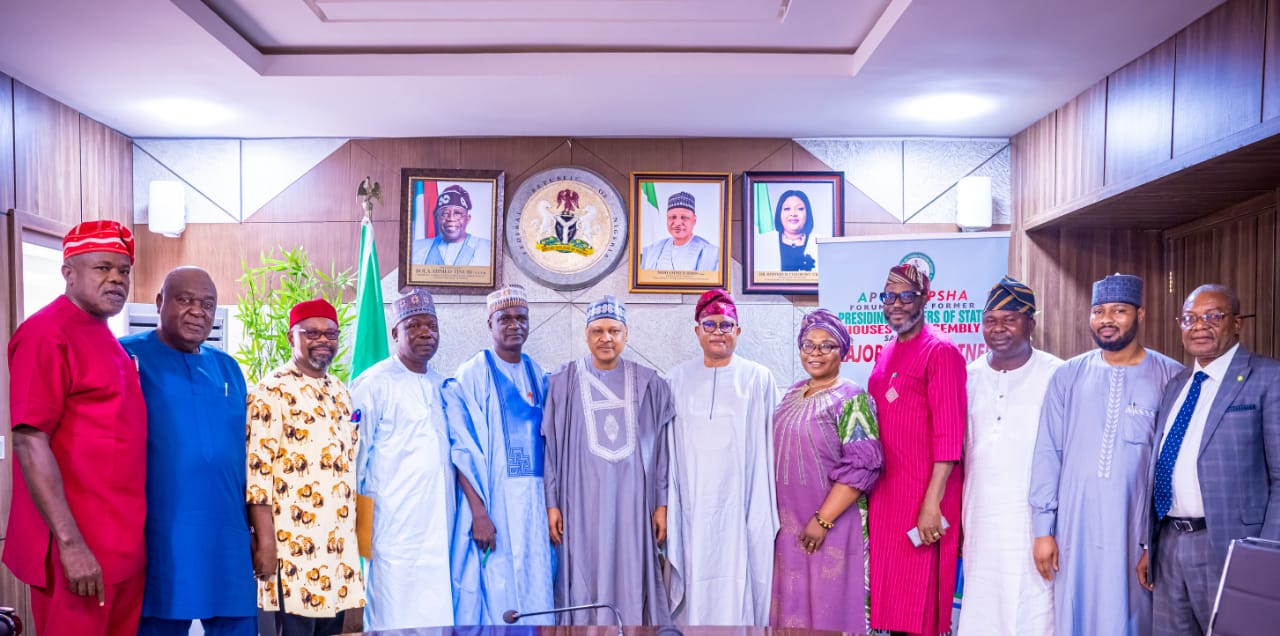
The Information Minister stated this whilst receiving the leadership of the APC Forum of Former Presiding Officers of State Houses of Assembly (FOPSHA), led by its Chairman, Senator Wasiu Esinlokun, on a courtesy visit in Abuja, Nigeria’s capital.
According to him, the Tinubu administration had taken bold decisions that previous governments were unwilling to implement, noting that the removal of fuel subsidy and the unification of the foreign exchange market have strengthened public finances and created room for increased investment in infrastructure, education and other critical sectors.
READ ALSO: Information Minister Calls for Balanced Reporting on Northern Nigeria
“It was only President Bola Tinubu who had the courage, the vision and the determination to remove fuel subsidy. It was a difficult decision, but one that had become inevitable after decades of postponement. Today, there is fiscal headroom for governments at all levels to provide services to the people,” Idris said.
He stressed that improved revenues had enabled state governments to meet salary obligations and embark on capital projects, adding that many states that previously struggled financially were now in a stronger fiscal position.
According to the Minister, those who had served in state legislatures were well positioned to communicate government policies because of their close relationship with people at the grassroots.
He urged members of the Forum to use their experience and grassroots reach to intensify efforts in explaining the policies and programmes of President Bola Tinubu’s administration to Nigerians at the grassroots.
“We want you to go back to the grassroots and tell people about these policies and programmes of government and how they can help to deliver Nigeria. People need to understand better what these reforms are doing and how they will ultimately benefit the country,” he noted.
Idris also pointed to improvements in key economic indicators, saying Nigeria’s foreign reserves had risen above $50 billion while the country’s Gross Domestic Product (GDP) growth had exceeded four per cent.
“For the first time in many years, our foreign reserves have crossed the $50 billion mark, and our economy is growing at over four per cent. These are signs that the reforms are beginning to produce positive outcomes,” he disclosed.
The Minister said the Nigerian Education Loan Fund (NELFUND) had expanded access to tertiary education, disclosing that more than one million students had remained in school through the initiative.
He further cited ongoing infrastructure projects, including the Lagos-Calabar Coastal Highway, the Sokoto-Badagry Superhighway, the Ajaokuta-Kaduna-Kano gas pipeline and railway modernisation, as evidence of the administration’s commitment to stimulating economic growth and improving living standards.
“Reforms are never easy; they come with challenges and sacrifices, but once the benefits begin to materialise, Nigerians will appreciate why these difficult decisions had to be taken,” he said.
Speaking earlier, FOPSHA Chairman, Senator Wasiu Esinlokun, said the forum was committed to mobilising political support for President Tinubu ahead of the 2027 general elections, describing the administration’s reforms as necessary to reposition Nigeria’s economy.
“Our first assignment is to contribute immensely to the success of the APC and the re-election of President Bola Tinubu. That is why we have come to seek the cooperation and support of the Ministry of Information,” he noted.
He endorsed the administration’s economic policies, describing them as bold interventions that rescued Nigeria from a worsening fiscal crisis.
“Nigeria was at a very critical stage when President Bola Tinubu assumed office. Many states could barely pay salaries, while fuel subsidy had become unsustainable and was enriching a few people at the expense of the majority,” Esinlokun said.
He argued that the removal of fuel subsidy had significantly increased allocations to states, providing them with greater capacity to execute development projects and improve public services.
“A lot of states are now receiving far more from the Federation Account than they did previously. What we expect is for those resources to be applied prudently for the benefit of Nigerians,” he emphasised.
Esinlokun also commended the administration’s reforms in the foreign exchange market, education financing and infrastructure development, saying they demonstrated a clear commitment to repositioning the country’s economy.
“The government has shown focus by investing in infrastructure, education and economic reforms. These are policies that will strengthen Nigeria’s economy over time. I’m confident that the reforms will deliver sustainable economic growth and improve the welfare of Nigerians in the years ahead,” he said.
The Forum restated its commitment to mobilising grassroots support for the Renewed Hope Agenda through sustained engagement with Nigerians across the country.