Presentations at the unveiling of the “Nigeria Gender Profile and Roadmap to Equality 2030” have provided critical insights into sectoral developments, gender disparities, achievements and persistent challenges, underscoring Nigeria’s renewed drive to achieve inclusive growth and unlock the full potential of its population.
At the unveiling, held in Abuja, Dr. María José Moreno Ruiz, Chief Gender Officer of the African Development Bank Group, highlighted disparities across economic empowerment, education and skills, access to representation and cultural practices, as well as fragility and conflict.
She explained that the comprehensive gender profile assessment covered all sectors and was developed through “a collaborative and data-driven approach oriented to action.”
According to her, the report was developed through extensive consultations and analysis of gender disaggregated data involving diverse stakeholders to provide policy and investment guidance, align with national development strategies and promote scalable interventions.
Dr Ruiz noted that special attention was given to women and girls facing multiple forms of disadvantage through an intersectionality perspective.
Her presentation on the roadmap identifies eight priority actions through 2030, including strengthening systems, institutions and governance; establishing a gender-responsive legal framework; and advancing economic empowerment and justice.
Others are expanding skills and education opportunities; increasing leadership and representation; improving health, transport and social services; addressing fragility, conflict and climate resilience; and driving social norms and behavioural change.
Ruiz’s presentation acknowledged that despite Nigeria’s extensive institutional framework for gender equality, implementation continues to face challenges due to inadequate funding, limited human resources, weak coordination across government levels, insufficient institutionalisation of gender-responsive budgeting and inconsistencies arising from statutory, customary and religious legal systems.
She further stressed that strengthening institutional capacity, enhancing coordination and ensuring sustained financial commitment remain critical for effective implementation.
Presenting “The Roadmap to Equality 2030: Priorities and Actions”, the Special Assistant to the Minister of Women Affairs and Social Development on Strategy, Mike Imafidor, said, “Gender equality is not a women’s issue. It is a national growth strategy.”
He outlined a strategic pathway for advancing equality as a catalyst for national development, economic prosperity and social transformation, while underscoring the economic urgency of gender equality.
Imafidor cited projections indicating a potential 229 billion dollar addition to Nigeria’s Gross Domestic Product by 2030 through closing gender gaps in labour force participation, while noting that women and girls constitute 49.4 per cent of the country’s population.
He identified key gaps, including women holding only 4.2 per cent of National Assembly seats, maternal mortality standing at 512 deaths per 100,000 live births, low secondary school completion rates among girls in conflict-affected regions, limited access to formal credit for women-owned enterprises and persistent gender disparities in literacy.
He, however, noted encouraging progress, including improvements in Nigeria’s global gender gap ranking, increased female financial inclusion, strong representation of women in managerial positions and growing female leadership within the banking sector.
“The evidence is clear. The roadmap is set; as a nation, we must rise to this task, not as a favour to women and girls, but because Nigeria cannot afford to waste the potential of a single citizen.”
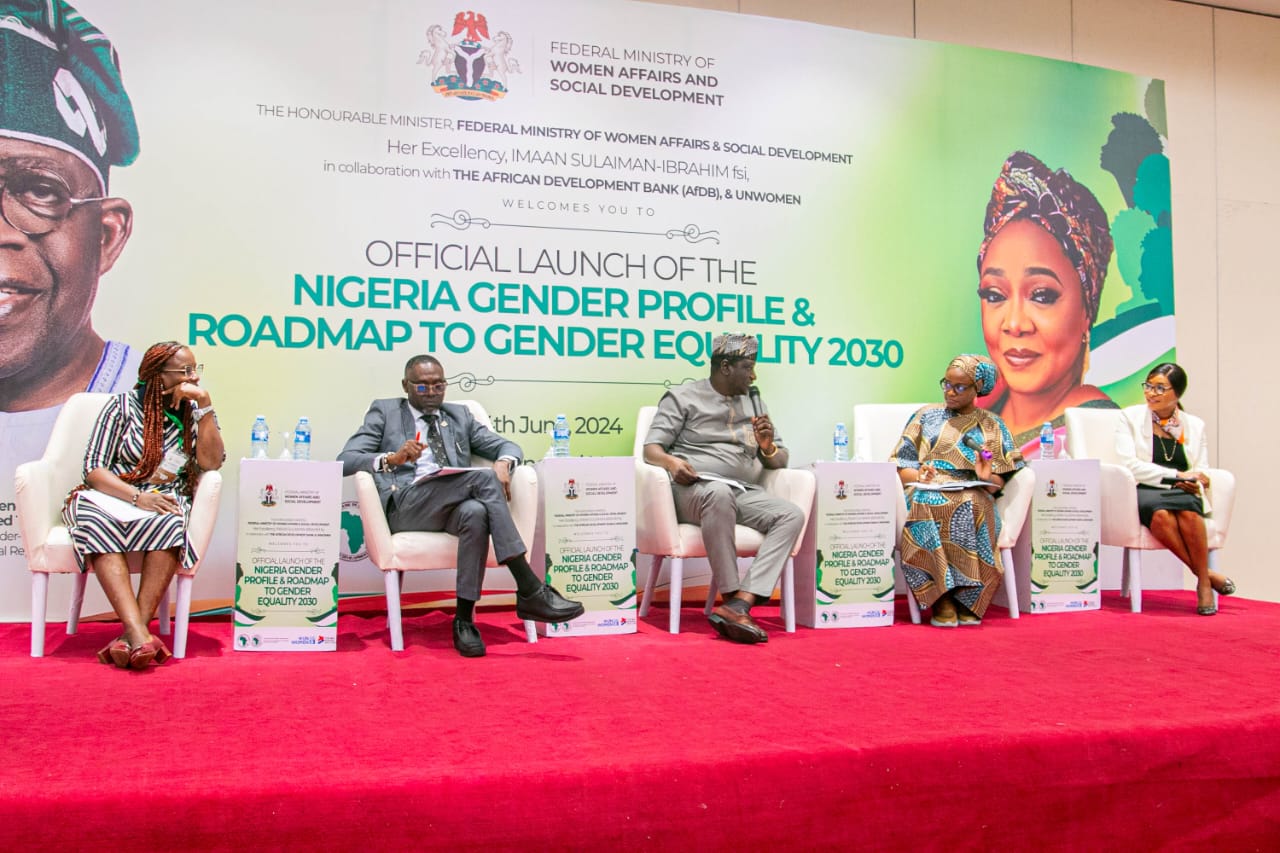
During an expert panel session on “Launch to Legacy: Implementing the Gender Profile and Roadmap to Equality 2030″, panellists called for stronger synergy among implementing agencies, development partners and stakeholders; institutionalised gender-responsive budgeting; technology-driven monitoring and evaluation systems; and greater grassroots ownership of the policy.
The panel also advocated translating the policy into multiple languages, including Braille, expanding awareness campaigns and ensuring adequate budgetary allocations backed by timely release of funds to transform commitments into measurable results.
Moderated by the Founder of She Forum Africa, Inimfon Etuk, the session shifted the conversation from policy articulation to implementation, with stakeholders stressing that the roadmap must evolve into a results-driven framework capable of delivering measurable improvements in the lives of women and girls across the country.
Panellist Peter Mancha called for stronger synergy among implementing agencies, development partners, civil society organisations, the private sector and community structures to ensure coordinated, accountable and sustainable implementation. He emphasised that gender equality outcomes would depend largely on strengthened institutional collaboration, effective policy coherence and clear accountability mechanisms across federal, state and local government levels.
Central to the discussions was the need to institutionalise gender-responsive budgeting as a critical tool for translating commitments into impact, with Dr Oluwole Odutola stressing that gender priorities must be reflected in national and subnational planning processes through adequate budgetary provisions, timely release of funds and robust expenditure tracking systems to guarantee value for money and tangible development outcomes.
The experts also advocated the deployment of technology and data-driven monitoring and evaluation systems to strengthen evidence-based decision-making, close implementation gaps and track progress against the roadmap’s targets.
They noted that reliable gender-disaggregated data remains essential for measuring results, informing policy adjustments and ensuring accountability.
In advancing the roadmap’s economic justice agenda, panelist Eugenia Ojeah encouraged women to leverage affirmative gender procurement opportunities and other empowerment initiatives to establish competitive enterprises in high-yield sectors of the economy.
Panel submissions further stressed the importance of ensuring that grassroots women are actively involved in planning, implementation and execution processes, thereby fostering ownership, inclusion and sustainability of interventions.
Submissions equally underscored the need to move beyond conferences and policy declarations by scaling up practical awareness campaigns, community sensitisation programmes and sustained advocacy initiatives capable of transforming discriminatory social norms and behaviours.
To guarantee inclusivity, panellist Niri Goyit recommended simplifying the roadmap into indigenous languages and Braille to expand access, understanding and participation among diverse population groups, including persons with disabilities.
The session concluded with a call for collective action, sustained financing and shared responsibility among government institutions, development partners, the private sector, traditional and faith leaders, women’s organisations and communities, stressing that the successful implementation of the roadmap would be instrumental to accelerating gender equality, strengthening social inclusion and unlocking Nigeria’s full development potential by 2030.