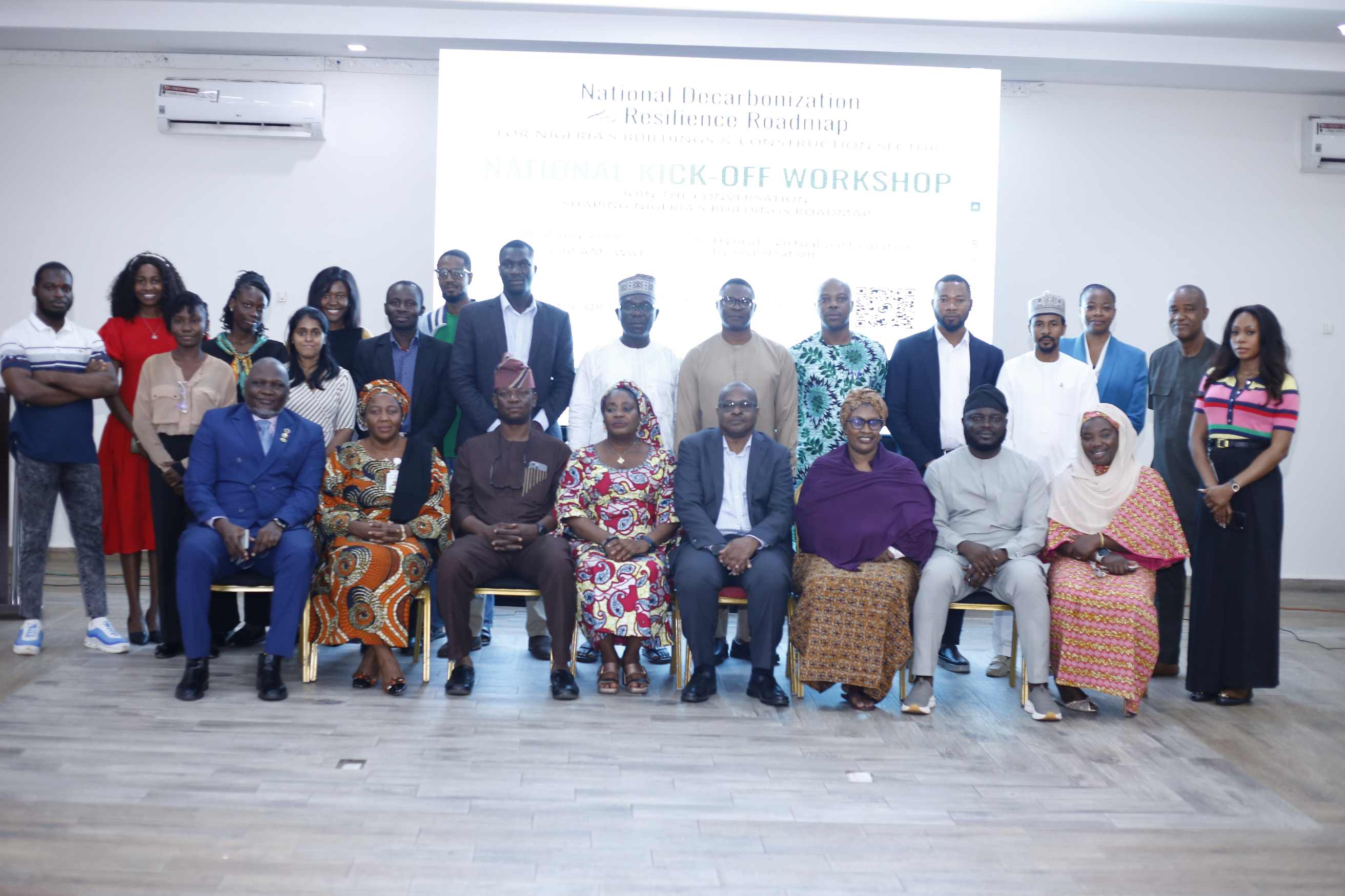
Nigeria has officially commenced the development of a National Decarbonisation and Resilience Roadmap for the Buildings and construction sector, reaffirming its commitment to sustainable urban development, climate action and low-carbon infrastructure.
The initiative was launched at the National Kick-off Workshop in Abuja, organised by the Green Building Council Nigeria (GBCN) in collaboration with the World Green Building Council, government institutions and development partners.
Declaring the workshop open on behalf of the Minister of Housing and Urban Development, Engr. Dr. Muttaqha Rabe Darma, Mrs Margaret Adejobi described the roadmap as a major step towards transforming Nigeria’s built environment into one that is sustainable, resilient and environmentally responsible.
READ ALSO:Green Building Council Drives Nigeria’s Climate Action Agenda
She said the roadmap would strengthen Nigeria’s implementation of the Paris Agreement, the Sustainable Development Goals (SDGs), the New Urban Agenda and the country’s Nationally Determined Contributions (NDCs), while promoting climate-responsive housing, resilient infrastructure and sustainable urban planning.

According to the minister, the buildings and construction sector remains one of the largest contributors to global greenhouse gas emissions, making it imperative for Nigeria to adopt innovative approaches to housing development, infrastructure delivery and urban planning.
He noted that the Federal Ministry of Housing and Urban Development has intensified efforts to mainstream climate action through the review of the National Urban Development Policy, the National Building Code and the National Physical Planning Standards.
The minister emphasised that the ministry is implementing the Renewed Hope Estates and Cities Initiative, which promotes climate-responsive housing designs, resilient infrastructure and urban renewal programmes aimed at improving living conditions, particularly in vulnerable communities.
He stressed that government alone could not achieve the transition to a decarbonised built environment and called for stronger collaboration among government agencies, the private sector, development partners, professional bodies, academia and civil society organisations. He also urged stakeholders to increase investment in green infrastructure, climate finance, energy-efficient building materials and sustainable urban development.
Earlier, Chairman of the National Multistakeholder Working Group for Decarbonised and Resilient Buildings, Town Planner Grace Bitrus described the launch as the beginning of a transformative national process that would reshape how Nigeria plans, designs, constructs and manages its buildings and communities in response to climate change.
She commended the Green Building Council Nigeria for championing sustainable building practices and fostering collaboration among key stakeholders, noting that Nigeria’s rapid urbanisation presents a unique opportunity to embrace low-carbon, energy-efficient and climate-resilient development.
Bitrus said the roadmap would align with Nigeria’s Climate Change Act, Nationally Determined Contributions and the Long-Term Low Emission Development Strategy while providing practical solutions to address challenges within the buildings and construction sector.
She observed that a significant proportion of Nigeria’s future buildings are yet to be constructed, giving the country an opportunity to adopt sustainable construction practices that would reduce emissions, strengthen resilience and contribute to long-term economic growth.
Bitrus urged participants to contribute practical recommendations that reflect Nigeria’s realities, emphasising that the success of the roadmap would depend on sustained collaboration and shared responsibility.
Also speaking, the Assistant Director of Renewable Energy at the Federal Ministry of Power, Engineer Temitope Dina, reaffirmed the ministry’s commitment to supporting the initiative through policies and programmes that promote energy efficiency and renewable energy integration.
He said the buildings and construction sector accounts for about 37 per cent of global energy-related greenhouse gas emissions, underscoring the urgent need to improve building energy performance and accelerate the deployment of clean energy technologies.
Dina highlighted several ongoing government initiatives, including the Building Energy Efficiency Code (BEEC), the implementation of Minimum Energy Performance Standards (MEPS), the deployment of decentralised renewable energy solutions and the solarisation of public buildings.
According to him, the National Decarbonisation and Resilience Roadmap will provide a strategic framework for coordinating government policies, mobilising investment and strengthening partnerships to build an energy-efficient, climate-resilient and sustainable built environment across Nigeria.
Presenting the strategic framework, Zinatu Malumfashi of the Federal Ministry of Power said the roadmap was developed to provide a coordinated approach to reducing carbon emissions while strengthening the resilience of Nigeria’s built environment.
She explained that the initiative responds to the country’s rapid urbanisation, increasing climate risks and the need to prevent long-term dependence on carbon-intensive construction practices.
Malumfashi said the roadmap seeks to bridge the gap between policy ambitions and implementation by creating a shared platform for collaboration among government institutions, development partners, the private sector and other stakeholders.
She noted that the framework focuses on reducing operational emissions from buildings, lowering the carbon footprint of construction materials and promoting cleaner, more efficient development pathways.
According to her, the roadmap will also improve the resilience of buildings and infrastructure against flooding, extreme heat and other climate-related hazards while supporting affordable housing, healthier communities and sustainable economic growth.
Delivering a presentation on the implementation strategy, Engineer Yisa of the Federal Ministry of Power said the roadmap establishes clear priorities for transforming the buildings and construction sector through coordinated action involving government, industry, academia, financial institutions and development partners.
He explained that the framework covers policy and governance, resilient land-use planning, sustainable housing development, retrofitting existing buildings and expanding the use of low-carbon construction materials.
Yisa said implementation would be carried out in phases, with short-, medium- and long-term targets extending to 2060, when Nigeria aims to achieve a fully decarbonised and climate-resilient built environment.
He added that the roadmap would improve investment readiness by mobilising climate finance, encouraging strategic partnerships, creating green jobs, strengthening local value chains, improving the quality and affordability of housing and enhancing the resilience of communities to climate change.
The workshop brought together policymakers, development partners, professional bodies, financial institutions, academics, industry experts and civil society organisations to begin the process of developing a comprehensive roadmap that will guide policies, investments and practical actions towards a sustainable, energy-efficient and climate-resilient buildings and construction sector in Nigeria.