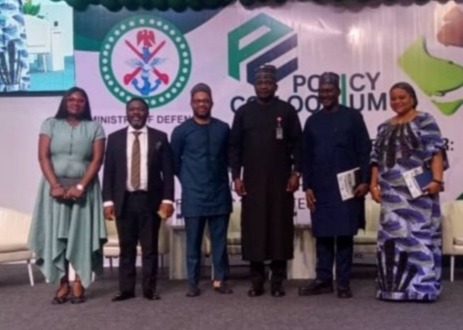
The Minister of Defence, General Christopher Musa (rtd.), has called for renewed strategic thinking, institutional adaptation and sustained national commitment to strengthen Nigeria’s response to an increasingly complex security environment.
General Musa made the call at the 2nd Policy Colloquium 2026, held at the Armed Forces Events and Multipurpose Centre, Asokoro, Abuja, where he said the changing character of contemporary threats required Nigeria to continually reassess its capabilities and strengthen its preparedness to protect national interests.
The Minister said the administration of President Bola Ahmed Tinubu had reaffirmed its resolve to strengthen national security and provide the Armed Forces with the capabilities required to protect the nation, stressing that a secure and stable Nigeria remained essential to sovereignty, democratic institutions and national development.

He said the strategic frontier that Nigeria must protect now spans land, maritime, air and cyber domains, making intelligence coordination, joint operations and interoperability between the Armed Forces and relevant institutions increasingly important.
The Defence Minister also identified artificial intelligence, unmanned systems, surveillance and reconnaissance and cyber capabilities as technologies reshaping contemporary military operations and the wider strategic environment. He stressed that Nigeria must invest in relevant technologies while developing the human, doctrinal and institutional capacity required to integrate them effectively.
READ ALSO: Defence Minister Reaffirms National Security Mandate Amid APC Appointment
The Minister further underscored the importance of strengthening Nigeria’s defence industrial base, noting that technological advancement must be matched by the capacity to sustain and develop the capabilities required for national defence.

He expressed the expectation that the colloquium would generate practical perspectives and recommendations capable of contributing to Nigeria’s evolving defence architecture, before declaring the event open.
Also speaking at the event, the Minister of Information and National Orientation, Alhaji Mohammed Idris, represented by the Director-General of the National Orientation Agency, Lanre Issa Onilu, said national security must now extend beyond traditional territorial threats to include protection of Nigeria’s information and cognitive space.
Onilu said misinformation could spread faster than verified facts, while artificial intelligence had made it possible to produce increasingly convincing fake images, videos and voices capable of manipulating public opinion, deepening social divisions and undermining confidence in democratic institutions.
He described cognitive security as the resilience of society against manipulation, propaganda and engineered falsehoods, stressing the need to ensure that citizens are able to make informed decisions based on credible information.
The Minister’s representative said the response required stronger institutional communication, media and information literacy and collaboration among government institutions, technology platforms, media organisations, academics and civil society.
He stressed that government must communicate clearly and promptly to prevent information gaps from being exploited by false narratives.
“The most effective response to disinformation is not propaganda. It is truth, transparency, and credibility,” the Minister said.
Onilu also stressed that efforts to confront deliberate deception must be balanced with the protection of freedom of expression, while government and relevant institutions respond to incitement and coordinated attempts to destabilise society.
The Special Adviser to the President on Media and Public Communication, Dr Sunday Dare, said effective management of Nigeria’s borders must balance national security with legitimate economic activity and regional cooperation.
Dare stressed that the openness of Nigeria’s borders should not be interpreted as an absence of sovereign controls, pointing to the roles of immigration, customs and other paramilitary institutions operating at the nation’s borders.
“Our borders are open. There are no open borders without controls.”
He said legitimate business activities take place across Nigeria’s major borders and maintained that border management should support economic development while preserving the country’s ability to control movement across its sovereign frontier.
The Coordinating Director, the African Continental Free Trade Zone (AfCFTA) Law and Policy Programme Division, Office of the Director-General, National Institute for Legislative and Democratic Studies, Muhammed Tawfiq Ladan, presented a policy framework addressing the changing nature of Nigeria’s sovereign frontier.
Ladan anchored the framework on Section 14(2)(b) of the 1999 Constitution, as amended, which provides that the security and welfare of the people shall be the primary purpose of government.
His paper identified four core priorities: redefining the sovereign frontier, strengthening strategic defence architecture, deploying emerging technologies as force multipliers and preserving democratic integrity.
Ladan also recommended stronger inter-agency data sharing, a centralised AI-driven joint threat-intelligence fusion capability and expanded specialist training in cybersecurity, electronic warfare and algorithmic analysis.
The policy framework further proposed legislative action on emerging technologies, including artificial intelligence, autonomous systems and facial recognition, alongside appropriate oversight mechanisms to safeguard civil liberties, accountability and responsible deployment.