Youths in Plateau State, north-central Nigeria, have unveiled a charter of demands aimed at addressing unemployment, improving security and promoting inclusive governance, while establishing a framework to hold political leaders accountable for their promises ahead of the 2027 general elections.
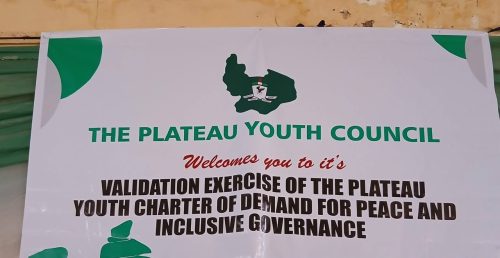
The Plateau Youth Charter of Demands for Peace and Inclusive Governance was developed by the Plateau State Youth Council (PYC), with technical support from the Youth Initiative Against Violence and Human Rights Abuse (YIAVHA).
The document is based on a survey of 782 young people across the state’s 17 local government areas and outlines priorities in employment, peacebuilding, electoral participation and youth inclusion. It seeks to ensure that young people’s priorities feature in candidates’ policy agendas and that commitments made during campaigns can be assessed after the election.
Speaking at a stakeholders’ validation exercise in Jos, the Plateau State capital, the Plateau State Youth Council Chairman, Mr Pannan Dafar, said the charter would provide a unified platform for young people to engage governorship aspirants and ensure their concerns were reflected in government policies and programmes.
He observed that politicians often relied on young people during election campaigns but failed to involve them adequately in governance after assuming office.
“The survey identified unemployment as the leading concern among respondents, with 57.7 per cent citing it as a major challenge. Farmer-herder conflicts followed at 49 per cent, while 47.3 per cent identified drug and substance abuse as a major concern. To address these challenges, the charter recommends low-interest loans and grants for young entrepreneurs, improved government support for farmers, investment in agro-processing, and the establishment of vocational centres and technology hubs to equip young people with relevant skills.” Dafar said.
The PYC chairman reiterated that politicians often relied on young people’s energy and ingenuity to win elections but failed to include them in governance after assuming office. He also disclosed that the council planned to organise town hall meetings with all governorship aspirants after the charter’s validation.
“The charter was designed to give young people a common platform for engaging political aspirants and ensuring that their concerns informed government policies and programmes. The document was developed through surveys, town hall meetings and community-level consultations, including efforts to reach young people without smartphones. It also incorporates the perspectives of young women and persons with disabilities.” Dafar stated.
He further called for stronger community-based security structures, dedicated funding for youth-led peacebuilding initiatives and early-warning systems to prevent violence.
“The charter therefore advocates greater youth representation in policy formulation, security committees and public planning processes. It also recommends reducing financial barriers that discourage young people from contesting elections and introducing sanctions against electoral violence, hate speech and misinformation.” Dafar added.
The Executive Director of the Youth Initiative Against Violence and Human Rights Abuse (YIAVHA), Mr Jacob Pwakim, said the charter would provide measurable indicators for evaluating the performance of elected officials against their campaign promises.
He explained that the initiative was supported under YIAVHA’s Building Bridges for Peace project through the SPRING programme, with funding from the United Kingdom’s Foreign, Commonwealth and Development Office.
“To sustain the initiative beyond the elections, the charter proposes a multi-sectoral implementation committee comprising government agencies, civil society organisations, youth groups, peacebuilding organisations and development partners. The committee would monitor compliance with commitments made by elected officials during the 2027–2031 administration. Other proposals include an independent Plateau Youth Advisory Council, biannual government-youth dialogues and youth participation in budget consultations.” Pwakim added.
Similarly, a participant at the meeting, Nan’akyen Yarima, expressed displeasure over the exclusion of young people from governance, noting that their participation often diminished after politicians secured electoral victories. She described the charter as an opportunity for young people to influence policies that affected their future.
The PYC said it planned to engage governorship aspirants to secure their commitment to the charter before the 2027 elections and present the initiative to the National Youth Council of Nigeria for possible adoption at the national level.
The council expressed hope that the charter would strengthen youth participation in governance and establish a sustained platform for policy engagement and accountability in Plateau State.