Across the world, the sea remains a major artery of international trade, connecting economies, moving goods, and supporting millions of livelihoods. More than 80 per cent of global trade is transported by sea, making the maritime sector vital to the global economy.
It is against this backdrop that the international maritime community marks World Maritime Day on the final Thursday of September each year. Led by the International Maritime Organization, IMO, the observance highlights the importance of safe, efficient, and sustainable shipping.
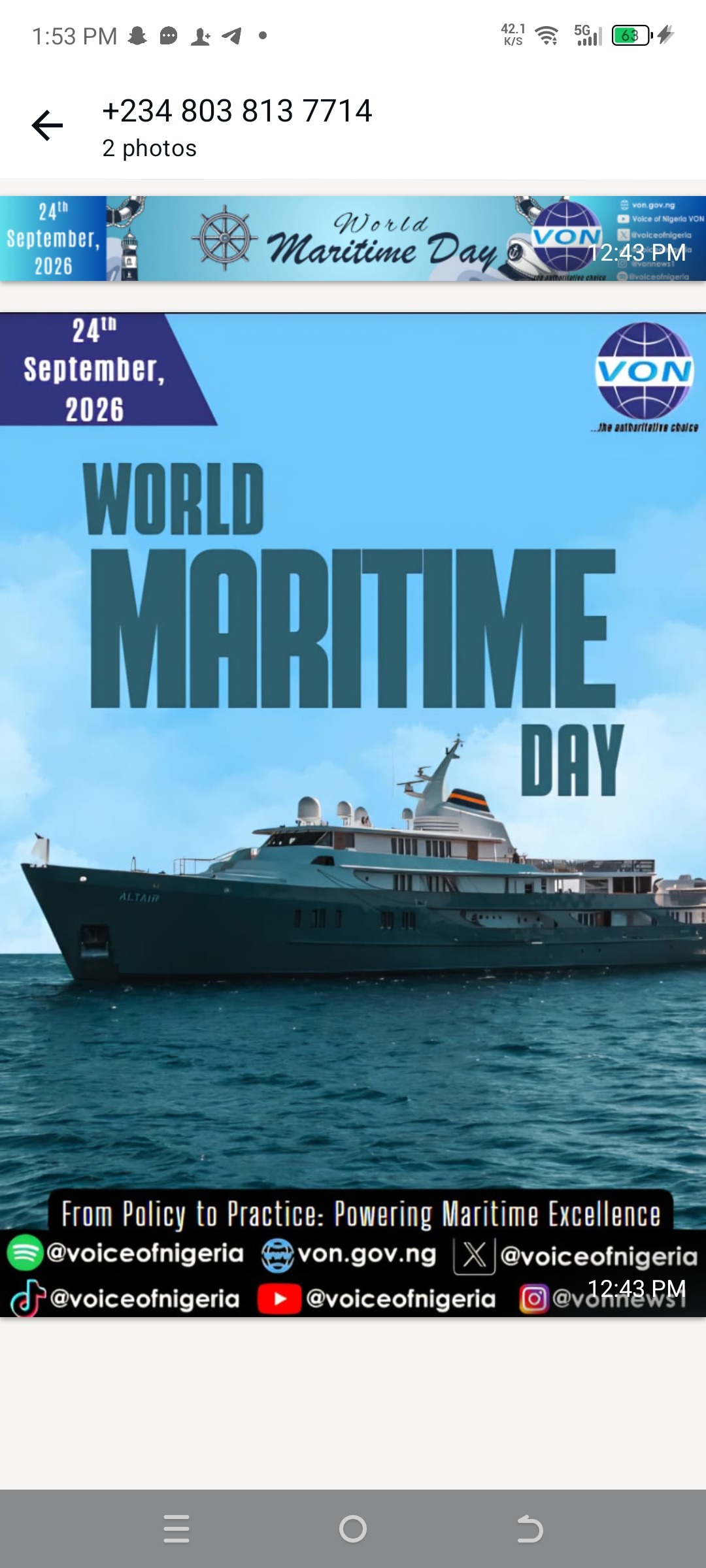
This year’s World Maritime Day, on September 24, carries the theme, “From Policy to Practice: Powering Maritime Excellence.” For the first time, the theme will run across 2026 and 2027, emphasising the need to translate maritime policies into implementation, enforcement, training, and results.
For Nigeria, that message is particularly relevant.
With about 853 kilometres of coastline, extensive inland waterways, and a strategic position along the Gulf of Guinea, Nigeria has enormous maritime potential. The sector offers opportunities in shipping, ports, logistics, fisheries, marine tourism, offshore energy, and the Blue Economy.
Yet, the country has not fully converted this advantage into sustainable economic growth.
More than 90 per cent of Nigeria’s international trade is transported by sea. However, Nigerian operators have faced limited access to finance, inadequate infrastructure, insufficient indigenous vessels, and skills. The Cabotage Vessel Financing Fund, CVFF, remained largely inaccessible for more than two decades, while many seafarers struggled to obtain the sea-time and certifications required to advance their careers.
The Nigerian Government has taken steps to address these challenges, including disbursing the CVFF to eligible indigenous operators, training 272 cadets through the Nigerian Maritime Administration and Safety Agency, and plans for a Nigerian National Shipping Line Maritime Centre of Excellence.
Government efforts also focus on strengthening maritime infrastructure, improving regulation, and developing the Blue Economy to increase indigenous participation and retain more value in Nigeria.
These are important steps, and the government deserves credit for advancing initiatives aimed at unlocking the sector’s potential. But the real test is whether these efforts translate into measurable results.
That is the essence of “From Policy to Practice.”
For Nigeria, policy must mean financing that reaches indigenous shipowners, training that produces skilled seafarers, effective enforcement of regulations, efficient ports, and infrastructure that enables Nigerian businesses to compete
It must mean clear targets, realistic timelines, and accountability.
Maritime policy should, therefore, be measured not simply by policies announced but by ships owned, jobs created, businesses developed, revenue generated, and economic value retained in Nigeria.
A stronger indigenous shipping industry can create jobs, while efficient ports and coastal shipping can reduce costs and strengthen commerce.
But no single agency can achieve this alone. Shipping, ports, inland waterways, fisheries, marine tourism, offshore energy, and logistics must be developed as interconnected components of a coordinated Blue Economy strategy.
The Nigerian government has set important initiatives in motion. The next step is to sustain them, strengthen implementation, and ensure that their benefits reach Nigerian businesses, workers, and communities.
From policy to practice and from potential to prosperity, Nigeria must now turn its maritime wealth into lasting economic value.