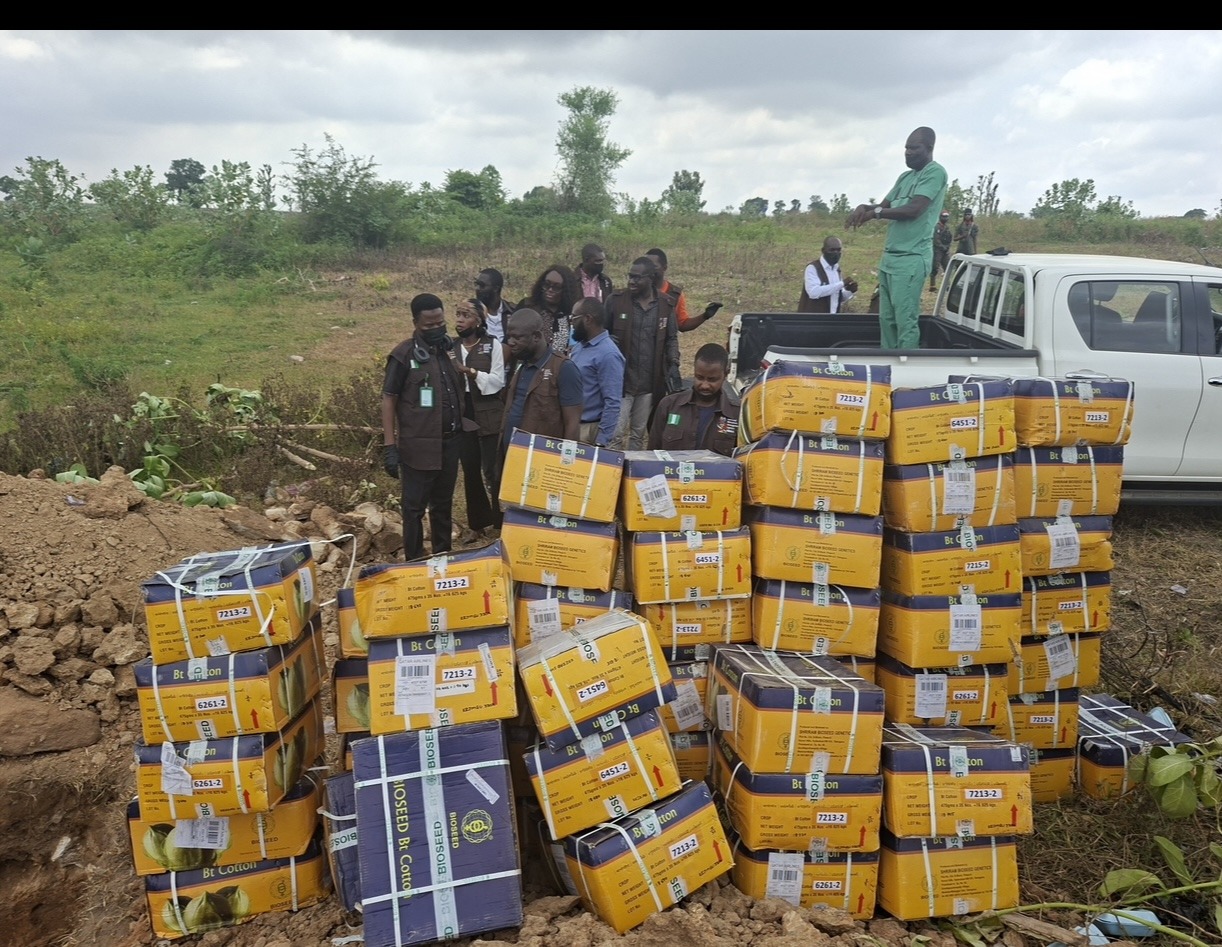
The Environmental Health Council of Nigeria (EHCON), in collaboration with the National Biosafety Management Agency (NBMA), has confiscated and destroyed consignments of seedlings and seeds valued at about ₦40 million that lacked the required regulatory certification and were suspected to be genetically modified organisms (GMOs).
The enforcement action forms part of the Nigerian Government’s efforts to strengthen biosafety regulation, safeguard public health, protect the environment and preserve Nigeria’s agricultural biodiversity.
EHCON Registrar, Dr Yakubu Mohammed Baba, described the operation as a proactive measure aimed at curbing the illegal importation of seeds, including GMO and non-GMO varieties, without proper government certification.
ALSO READ: Governor Alia Presents Palm Seedlings to Benue Journalists
Baba further said the exercise was geared towards ensuring a healthier and safer environment for all Nigerians.
He noted that the council remains committed to working closely with relevant institutions to protect human lives and the environment.
“Today we witnessed the disposal of 57 cartons of transgenic hybrid cotton seeds that were found to have been introduced into the country by Fiyah Global Concept Limited.
“Following investigation, surveillance activities and intelligence gathering, it was confirmed that these seeds were introduced into the country without adherence to the regulatory biosafety rules and regulations,” the EHCON Registrar stated.
Reacting to questions regarding the decision to bury the seedlings, Baba said, “We did not burn them because we want to reduce emissions. So we have to bury them.”
Also speaking during the exercise, the Director-General of NBMA, Dr Fatima Suleiman Zuntu, stated that the action followed intelligence gathering, surveillance activities, compliance monitoring, and a comprehensive investigation conducted by the agency.
According to the Director-General, investigations established that the transgenic hybrid cotton seeds, traced to Fiyah Global Concept Limited, were introduced and handled without the regulatory approvals and oversight required under the National Biosafety Management Act and applicable regulations governing genetically modified organisms in Nigeria.
Dr Zuntu emphasised that the matter constituted a regulatory compliance breach and not a safety incident.
“At no point did the unauthorised activities pose a threat to human health, animal health, or the environment. Nevertheless, compliance with established regulatory procedures remains a fundamental requirement for maintaining the integrity, credibility, and effectiveness of Nigeria’s biosafety system,” the Director-General of NBMA emphasised.
She further stressed that, in addition to the disposal exercise, other regulatory sanctions have been imposed on Fiyah Global Concept Limited in accordance with NBMA’s administrative processes and the provisions of the law.
Dr Zuntu stated that the agency’s actions were driven solely by its statutory responsibility to protect Nigerians, safeguard biodiversity and the environment, and preserve public confidence in the regulation of modern biotechnology.
“This exercise sends a clear signal that no individual, institution, or organisation is above the law. Regulatory compliance is not optional. The National Biosafety Management Agency will continue to enforce the law without fear or favour whenever violations of biosafety regulations…” She warned.
The Director-General added that NBMA will continue to discharge its mandate firmly to protect human health, preserve the environment and biodiversity, and ensure that the benefits of modern biotechnology are realised safely and responsibly for the benefit of all Nigerians.
The inspection exercise is intended to deter the illegal importation, distribution, and cultivation of seeds, whether genetically modified or non-genetically modified, that have not undergone the mandatory approval, risk assessment, and certification processes stipulated under Nigeria’s biosafety regulations.